

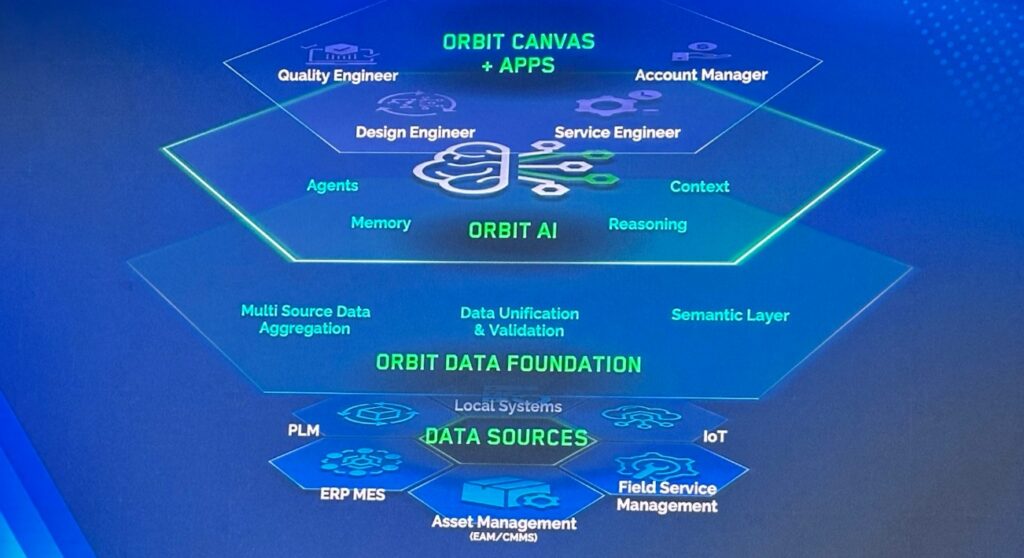
At PTC Next 2026, artificial intelligence was embedded throughout the company’s product portfolio, appearing in CAD, PLM, service management, collaboration tools, and product data platforms. Yet according to analyst Oleg Shilovitsky, the event revealed a deeper issue that extends beyond the deployment of AI assistants: the absence of a shared product context that allows these tools to understand and reason from the same body of knowledge.
The article argues that while AI capabilities are becoming widespread across engineering software, each application still operates within its own information boundary. CAD systems capture design intent and engineering decisions, but much of that knowledge remains confined to the design environment. PLM systems record changes, approvals, and product structures, yet often fail to preserve the reasoning behind those decisions. Service applications, by contrast, retain a richer operational context because technicians and support teams require explanations and historical knowledge to solve real-world problems.
A recurring theme throughout the conference was the growing importance of AI agents. However, Shilovitsky notes that intelligent agents can only be as effective as the information available to them. When product knowledge is fragmented across disconnected systems, AI assistants become specialized tools rather than participants in a broader engineering workflow. As a result, organizations risk creating multiple intelligent systems that cannot collaborate effectively because they lack a common understanding of the product.
The article highlights PTC’s introduction of concepts such as context layers, collaboration platforms, and data services intended to support AI-driven workflows. Nevertheless, the author contends that the company stopped short of fully connecting these elements into a unified framework. The key challenge is not adding more AI features but establishing a shared context layer that captures decisions, intent, and reasoning throughout the product lifecycle.
The article concludes that the future of AI-enabled PLM will depend less on the number of assistants available and more on whether organizations can build a connected product knowledge foundation. Without that shared memory, AI remains fragmented across tools; with it, a truly intelligent digital thread becomes possible.
