

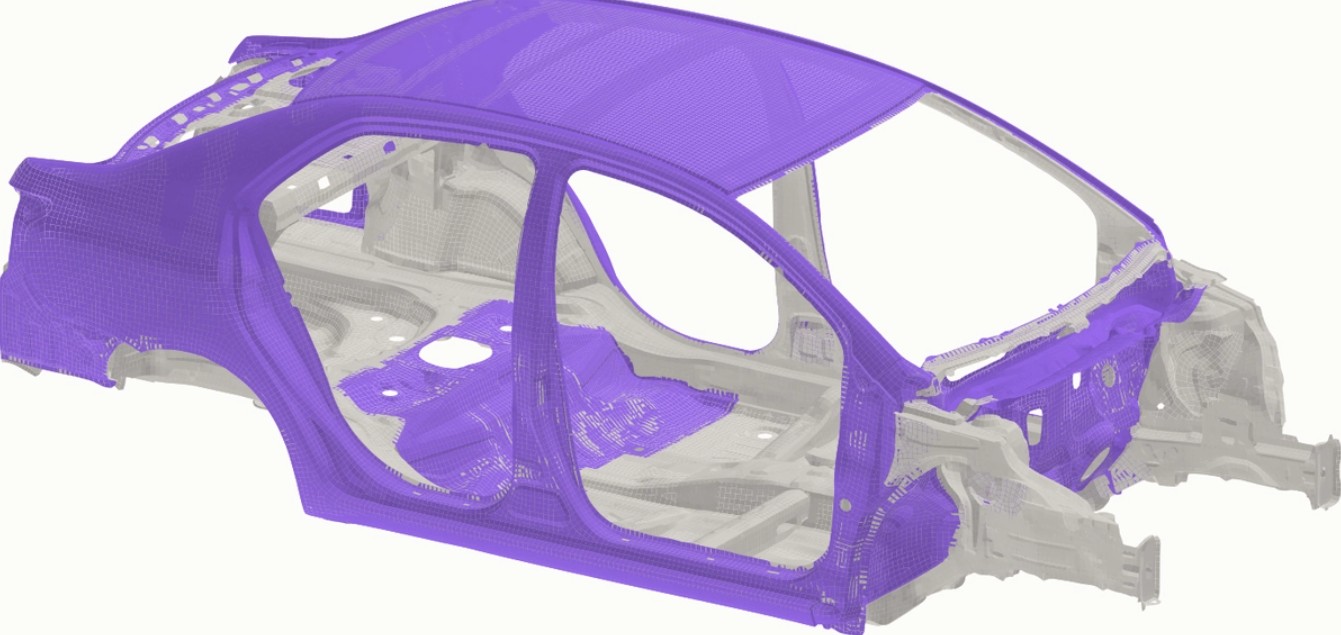
Luminary has introduced SHIFT-NVH, a Large Physics Model designed to speed up noise, vibration, and harshness analysis for automotive body design. The model addresses a late-stage engineering challenge: once vehicle body geometry is fixed, engineers primarily adjust sheet-metal gauge and material to control vibration and reduce weight. Testing every combination traditionally requires repeated finite element simulations.
SHIFT-NVH uses a neural network trained on FE simulation results to predict the complete vibration field for new design configurations without rerunning the solver. Luminary trained the model using a 2010 Toyota Yaris body-in-white containing 213 parts and 130,713 nodes. Fifteen parts, including the roof, side panels, firewall tray, and rear floor, were allowed to vary by up to 30% from their nominal gauge. The study included steel, aluminum, and magnesium designs evaluated at 30, 50, 80, and 110 km/h.
The model accepts 19 inputs, including 15 part gauges, material properties, and vehicle speed. It predicts RMS acceleration in three directions at every surface node. Across 192 test cases based on previously unseen designs, SHIFT-NVH achieved a median relative field error of 1.1% and a median part-level RMS error of 0.47%. It also correctly identified the direction of vibration changes for parts showing changes of at least 5% in 99.5% of cases.
For engineers, the main benefit is rapid design screening. SHIFT-NVH can help compare lightweighting options, identify vibration-sensitive components, and evaluate supplier-proposed gauge or material changes without sharing the complete body FE model.
The current model is limited to one fixed body geometry and a defined design range. Luminary therefore positions it as a screening tool rather than a replacement for detailed FE analysis and physical testing, which remain necessary for final engineering decisions.
