

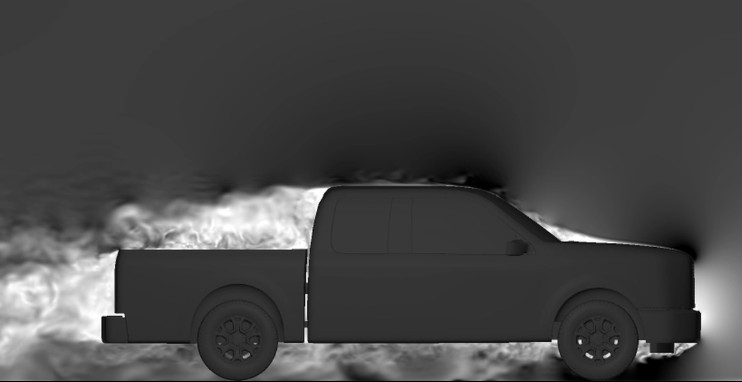
Luminary has introduced SHIFT-Truck, a Large Physics Model (LPM) designed to accelerate aerodynamic analysis during pickup-truck development. The AI-powered system predicts aerodynamic performance directly from vehicle geometry, enabling engineers and designers to evaluate changes without running computationally expensive simulations for every design iteration.
Pickup aerodynamics significantly affects fuel consumption and electric vehicle range. At highway speeds, aerodynamic drag accounts for approximately two-thirds of a light-duty vehicle’s tractive energy. Pickup trucks present additional challenges because of their larger frontal areas, open beds, and complex airflow patterns.
SHIFT-Truck addresses these challenges by learning from high-fidelity computational fluid dynamics (CFD) simulations. It predicts surface pressure and wall shear stress, allowing engineers to calculate aerodynamic forces and identify areas contributing to drag.
The model was developed using approximately 1,000 design configurations based on the Generic Truck Utility reference geometry. Its training simulations employed Delayed Detached Eddy Simulation (DDES) to capture complex airflow around the vehicle.
Testing demonstrated a median drag-coefficient prediction error of 3.8 counts and an R² value of 0.96. According to Luminary, exploring 2,000 design configurations through conventional simulation would require more than 110,000 Nvidia H100 GPU-hours. SHIFT-Truck performs comparable design-space exploration approximately 3,000 times faster.
The development also demonstrates the potential of transfer learning. By initializing SHIFT-Truck using Luminary’s existing SHIFT-SUV model, researchers reduced surface-pressure prediction errors by 9% to 23%, demonstrating that knowledge from one vehicle category can improve predictions for another.
For automotive engineers, the technology brings aerodynamic feedback into early styling decisions involving cab proportions, roof height, bed length, and other geometry changes.
High-fidelity CFD remains essential for validating selected designs and expanding training datasets. However, SHIFT-Truck enables faster exploration of alternatives, potentially reducing costly redesigns while supporting more efficient combustion and electric pickup development.
