

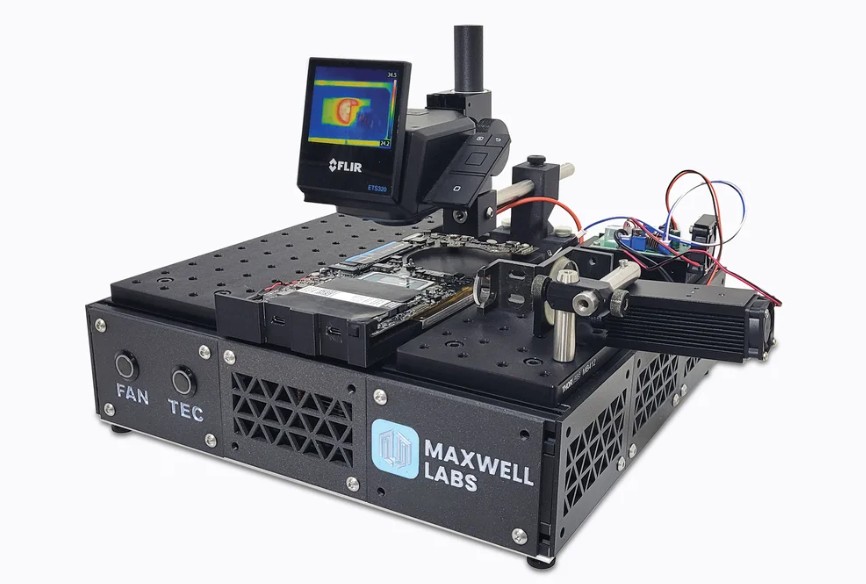
Researchers have developed a new way to cool semiconductors using laser-based photonic techniques rather than traditional air or liquid flow. The proof-of-concept system places a “photonic cold plate” above hot spots on a chip and uses laser-driven anti-Stokes fluorescence to extract heat. Early tests suggest this approach can dissipate twice the heat of current air and liquid cooling setups, tells IEEE Spectrum.
One of the major benefits is that this method could allow all parts of a chip to operate simultaneously rather than shutting down portions due to excessive temperature. That means hotter chips, faster clock speeds and better use of transistor real-estate. Because the laser-driven cooling acts at the point of maximum thermal load, it also supports advanced 3D-stacked chip architectures that today are limited by heat removal challenges.
Beyond raw performance, photonic cooling offers substantial energy savings. By reducing the need for high-flow air or liquid cooling, the system may cut a data centre’s cooling power by more than 50%. What’s more, the emitted light from the cooling process itself could be captured and converted back into electricity via thermophotovoltaics, achieving waste-energy recovery rates of up to 60%.
That said, significant hurdles remain before this technology becomes mainstream. Suitable materials for the photonic cold plate are still limited and must be refined for use at scale. Moreover, integrating laser cooling with current chip packaging and system designs will require close collaboration across semiconductor, optics and systems engineering domains.
The technique represents a bold step beyond traditional thermal management. If matured, it could reshape how chips and data centres are engineered, allowing higher power densities, smarter architectures and greener cooling.
