

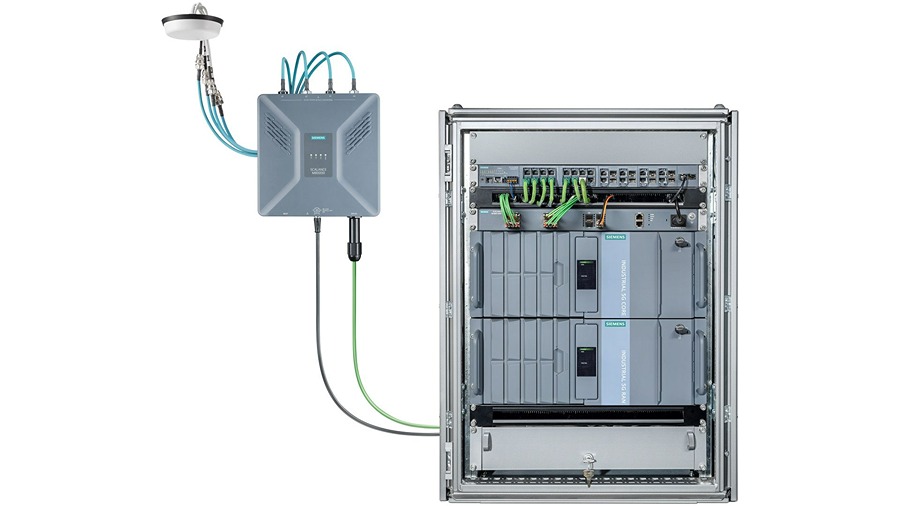
NUREMBERG, Germany, Apr 7, 2026 – Siemens is expanding its industrial private 5G infrastructure to the United States and seven additional countries, adding support for the 3.8 to 4.2 GHz spectrum and the US-specific CBRS band. The update introduces new radio units and extends coverage to 15 countries across Europe and the Americas, with a dedicated CBRS option for on-site deployment in U.S. factories across manufacturing, pharmaceuticals, food and beverage, pharmaceuticals, intralogistics, heavy industry, and crane operations.
Siemens has upgraded its 5G routers with built-in edge runtime, allowing applications to run on the device for real-time, AI-ready data processing without additional hardware.
The Connectivity Challenge in Modern Manufacturing
As AI use grows in factories, data volumes are increasing, and unlicensed Wi-Fi bands can struggle in dense industrial settings. Siemens uses licensed spectrum in its private 5G infrastructure to provide predictable connectivity with lower interference for industrial applications.
“The industrial world deserves a 5G solution that speaks its language,” said Axel Lorenz, CEO of process automation at Siemens. “With our private 5G infrastructure soon available in the United States, we’re giving manufacturers the tools to build their own reliable, secure digital backbone – on their terms, on their premises and fully under their control.”
A Solution Built from Industry, for Industry
Siemens developed its private 5G infrastructure around industrial requirements, including operational constraints and OT cybersecurity. It supports on-premises wireless networks that operate independently of mobile network operators and integrates with Siemens IT/OT systems within the Siemens Xcelerator portfolio.
The system supports automation protocols such as PROFINET and allows adjustment of upload and download capacity through TDD configuration. Configuration involves setting about 20 variables through a web-based dashboard intended for non-IT users.
TÜV has certified the infrastructure for wireless PROFIsafe communication. This allows use in safety-related applications when combined with Siemens 5G routers and Siemens’ Safety Automation Equipment.
The infrastructure will be available in the following countries where spectrum is allocated for private 5G networks:
- Newly added: Belgium, Canada, Finland, France, Norway, Poland, United Kingdom. USA (will be available in Summer 2026)
- Already available: Austria, Brazil, Denmark, Germany, Netherlands, Sweden, Switzerland
Integrated Industrial Connectivity Portfolio
At this year’s Hannover Messe, Siemens will present its industrial 5G as part of a broader connectivity stack that includes wired and wireless networking, switching, routing, industrial power supply, and OT network management. The portfolio includes managed and unmanaged switches that connect production cells, aggregation layers, and backbone networks. SITOP industrial power supplies support communication and automation infrastructure where stable power delivery is required.
Network management and diagnostics are handled through Siemens software for monitoring, diagnostics, and lifecycle management. Security is implemented through a zero trust architecture using SINEC Secure Connect. The SINEC Advanced Network Suite provides a network digital twin that allows engineers to model, simulate, validate, and optimize OT network configurations before deployment. For cybersecurity, Siemens includes the SINEC Security Suite, with Inspector, Monitor, and Guard solutions for identifying, tracking, and controlling threats across industrial networks.
Source: Siemens
About Siemens AG

Siemens AG is a technology company founded in 1847 and headquartered in Munich and Berlin, Germany. The company develops products and services in industrial automation, electrification, digital systems, and mobility. Its offerings include automation systems, industrial software, building technologies, rail transport systems, and power distribution solutions. Siemens also provides financial services and supports infrastructure projects. It serves industries such as manufacturing, energy, transportation, construction, and healthcare. The company works with enterprises, utilities, governments, and infrastructure operators worldwide. Siemens operates in more than 190 countries. It applies digital tools and AI to industrial and infrastructure use cases. Siemens holds a majority stake in Siemens Healthineers, a publicly listed healthcare technology company. Siemens has about 318,000 employees globally.
About Siemens Digital Industries

Siemens Digital Industries (DI), a division of Siemens AG, focuses on industrial automation and digitalization. Based in Nuremberg, Germany, the division provides software, automation systems, and digital services that support the full product and production lifecycle—from design and engineering to manufacturing and maintenance. With a history extending over six decades, Siemens DI serves key sectors including automotive, aerospace, pharmaceuticals, energy, and electronics. Its technologies, such as the Xcelerator platform and SIMATIC automation systems, are designed to integrate physical and digital processes, enabling data-driven manufacturing and operational efficiency. The division reports annual revenues exceeding €18 billion and employs approximately 70,000 people globally. Its portfolio supports manufacturers in implementing Industry 4.0 strategies by linking simulation, automation, and real-time data in scalable systems.
