

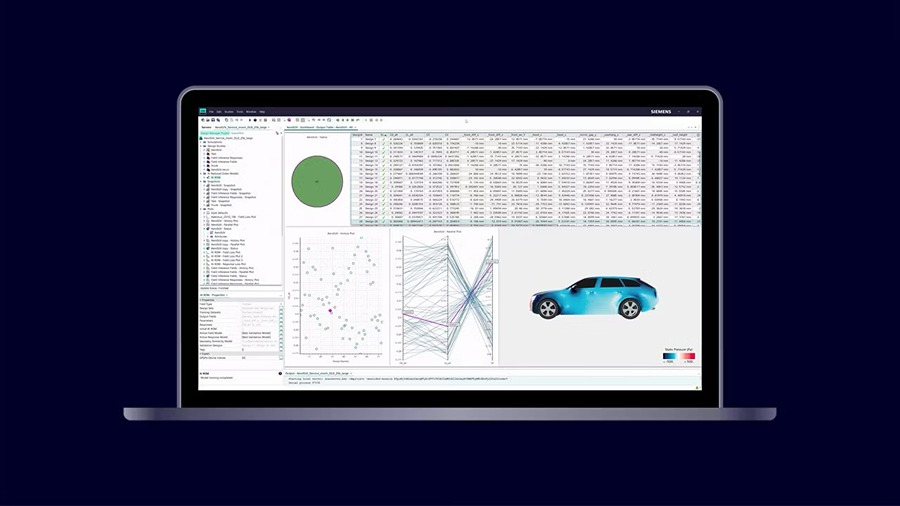
PLANO, TX, May 29, 2026 – Siemens has added Simcenter PhysicsAI to its Simcenter engineering simulation portfolio, allowing engineers to create AI reduced-order models from computational fluid dynamics data and evaluate design variations without repeatedly running full CFD simulations.
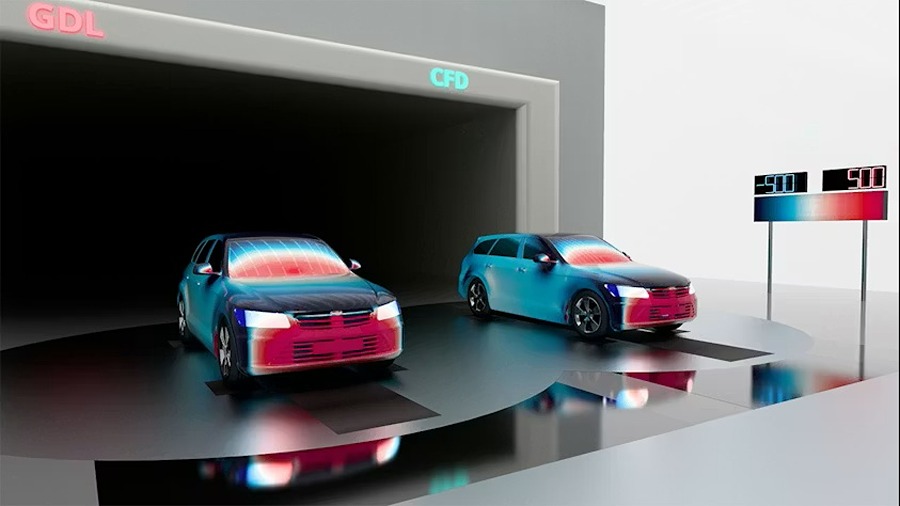
Simcenter PhysicsAI uses geometric deep learning technology from Simcenter STAR-CCM+ to train and validate AI models from simulation results. Engineers can run predictions on new geometries within the simulation environment while using CFD simulation as a validation reference. Siemens said Simcenter PhysicsAI can support what-if studies up to 1,000 times faster than traditional simulation workflows while using fewer computing resources.
“Engineering simulation isn’t limited by physics – it’s limited by how quickly we can explore possibilities. Our strategy is to help customers learn from past work, accelerate exploration, and use AI as a prescriptive engine for innovation. We’re not replacing deterministic truth – we’re making it scalable and immediate,” said Sam Mahalingam, executive vice president, Simulation, HPC and AI, Siemens Digital Industries Software. “We’re harnessing AI to help engineers rapidly explore and pinpoint the best solutions to their problems. Simcenter PhysicAI allows customers to target challenges with unprecedented speed and intelligence, frees teams from repetitive tasks and fragmented data and empowers engineers to focus on what matters most: driving creativity and accelerating innovation.”
Simcenter PhysicsAI shifts early-stage screening from solver runs to AI inference. It can also use historical data, newly generated results and previous design of experiments (DOE), studies to reduce repeated CFD simulation work.
Key Capabilities
Simcenter PhysicsAI supports AI reduced-order model creation and use through:
- Design space exploration: Evaluates performance across thousands of design variants in minutes and uses a transformer neural network architecture optimized for geometric data.
- Simulation data reuse: Trains AI models from historical data and newly generated results, including previous DOE studies, to reduce repeated CFD simulation runs.
- Iteration cycles: Moves early-stage screening from solver runs to AI inference. AI reduced-order models can be integrated into optimization studies to explore hundreds of design variants in hours instead of weeks.
- Validation tools: Uses error metrics and validation tools to quantify prediction accuracy and check whether AI models capture correct performance trends.
- GPU acceleration: Uses GPU acceleration for design exploration, with predictions running up to 100 times faster on GPU than CPU.
Availability
Simcenter PhysicsAI is available as an add-on to Simcenter STAR-CCM+. Existing and new customers will receive development and capabilities across the combined Siemens-Altair product portfolio.
Source: Siemens
About Siemens Digital Industries Software

Siemens Digital Industries Software, a business unit of Siemens AG, provides industrial software, hardware and related services through the Siemens Xcelerator platform. The company’s portfolio includes product lifecycle management, electronic design automation, simulation and digital twin tools, manufacturing operations management and low-code application development. These products support design, engineering and production workflows across sectors such as aerospace and defense, automotive, electronics and semiconductors, machinery, medical devices and process manufacturing. Siemens Digital Industries Software traces its origins to 1963 as United Computing, later becoming Siemens PLM Software in 2007 before adopting its current name. It supplies technologies that help organizations manage product, process data, and improve development and manufacturing efficiency across a range of industrial applications.
About Siemens
Siemens Corporation, the U.S. subsidiary of Siemens AG, operates across industry, infrastructure, transportation, and healthcare sectors. Founded in 1847, Siemens AG has more than 175 years of history and is headquartered in Munich, Germany. Its U.S. operations are based in Washington, D.C. The company maintains 24 manufacturing sites in the United States and employs over 50,000 people, serving customers in all 50 states and Puerto Rico. Siemens focuses on integrating digital and physical technologies to support customer needs in efficiency, urban development, and sustainable transportation. The company applies industrial AI – including generative AI – to use cases across sectors.
