

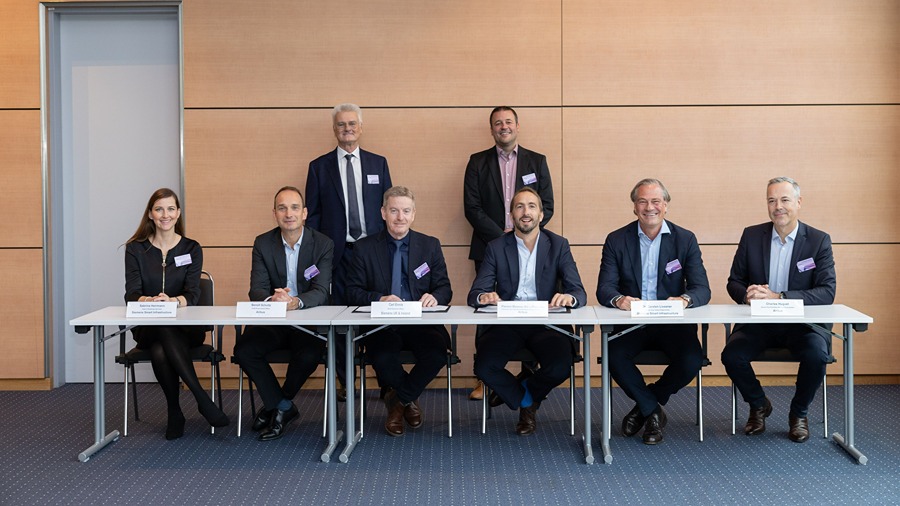
ZUG, Switzerland. Oct 14, 2025 – Siemens and Airbus have expanded their partnership with a new contract focused on reducing emissions at Airbus’ industrial sites in the U.S. and U.K. The initiative supports Airbus’ plan to lower its environmental footprint by minimizing CO₂ emissions and energy use. Under the framework agreement, Siemens will apply its decarbonization technologies to help Airbus achieve an annual reduction of 80 kt CO2e abated annually from 2030. The project will be led by Siemens’ Buildings business with support from Capgemini.
Decarbonization at Scale: Scalable Solutions for Measurable Impact
Siemens will assess each Airbus site and develop a decarbonization masterplan to reduce energy usage. Energy system twins will simulate and test different roadmaps to identify the suitable strategy for each site. Key elements include decarbonization of heat production via heat pumps, improving energy efficiency, and smart metering systems. The plan also involves integrating renewable energy sources and using energy management devices to monitor, control, and optimize usage across the sites. These actions support Airbus’ goals of reducing energy use by 20% and reducing Scope 1 and 2 greenhouse gas emissions by 85% by 2030, compared to 2015 levels.
Siemens has selected Capgemini to support the program’s first phase consulting, governance setup, and project management planning. Capgemini will also apply its expertise in digitalization and automation to enhance energy monitoring and measurement systems.
“Our collaboration with Airbus is built on years of mutual trust and shared ambition. It highlights Siemens’ capability to deliver smart and scalable technologies and services to reduce the carbon footprint of Airbus. At Siemens, we’re committed to making the energy transition not only sustainable, but also achievable and scalable, so that Airbus and other industrial leaders can confront climate challenges while boosting operational resilience and long-term competitiveness,” said Susanne Seitz, CEO of Buildings at Siemens Smart Infrastructure.
“We’re proud to be taking this important step toward making our operations more energy-efficient and future-ready. Collaborating with trusted partners is key in building a more resilient industrial footprint. The site-specific expertise from our Airbus colleagues in the U.K. and the U.S. combined with Siemens’ technical know-how will keep us on the path toward meeting our energy use and emission reduction targets,” said Florent Massou dit Labaquere, EVP operations of Airbus commercial aircraft.
Roadmap to 2030
The initial phase began in summer 2025 with creating decarbonization roadmaps for each Airbus site. Engineering studies will guide implementation, and infrastructure deployment is scheduled to start in 2026. Siemens may also operate and maintain the new systems to ensure efficiency and reliability.
Siemens and Airbus have collaborated for more than 50 years on projects in factory automation, industrial software, building systems, and safety technology. The new agreement extends this partnership to advance Airbus’ sustainability goals and reduce its operational environmental impact.
Source: Siemens
About Siemens Smart Infrastructure

Siemens Smart Infrastructure, a division of Siemens AG, is headquartered in Zug, Switzerland. The division focuses on integrating energy systems, buildings and industrial processes to improve efficiency and functionality. It offers a range of solutions including HVAC controls, fire safety systems, security, energy performance services, grid resilience tools and electric vehicle charging infrastructure. These solutions support industries such as data centers, energy and manufacturing. Siemens Smart Infrastructure addresses challenges related to urbanization and climate change by developing systems that span the entire energy value chain – from power generation to end use. The division also emphasizes cybersecurity to ensure secure, reliable operations in increasingly digital environments. As of fiscal year 2024, the division reported a profit margin of 17.3 percent and employed approximately 78,500 people worldwide.
About Siemens AG
Siemens AG, headquartered in Munich, Germany, is a global technology company serving the industrial, infrastructure, transportation, and healthcare sectors. Founded in 1847, Siemens provides products and services such as industrial automation systems, digitalization solutions, energy-efficient technologies, and medical diagnostic equipment. In fiscal year 2024, ending September 30, the company reported revenue of €75.9 billion and net income of €9.0 billion. Siemens employs approximately 312,000 people worldwide, with about 90,000 located in Germany. The company holds a leading position in automation, industrial software, and digital solutions, and owns a majority stake in Siemens Healthineers, a publicly listed medical technology company focused on diagnostics and healthcare systems. Siemens applies industrial and generative AI technologies to improve efficiency, operational performance, and sustainability across manufacturing, infrastructure, and mobility. Its solutions combine physical systems and digital tools to support industrial processes, smart infrastructure, and connected mobility applications.
About Airbus

Airbus is a leader in the aerospace sector, offering a portfolio that includes commercial aircraft, helicopters, defense and security solutions, and space systems. Founded in 1970, the company serves a industries including commercial aviation, defense, and space exploration. Airbus is organized into three divisions: Commercial Aircraft, Helicopters, and Defense and Space, delivering advanced solutions to customers worldwide. Headquartered in Toulouse, France, Airbus has established an international presence through its manufacturing, assembly, and research facilities. The company is at the forefront of sustainable aerospace innovation, with ongoing initiatives in alternative propulsion technologies and digital transformation. In fiscal year 2024, Airbus generated annual revenues of approximately €65.4 billion. With over 50 years of experience, Airbus remains a key player in global mobility, national security, and space exploration, maintaining its leadership in the aerospace and defense sectors.
