

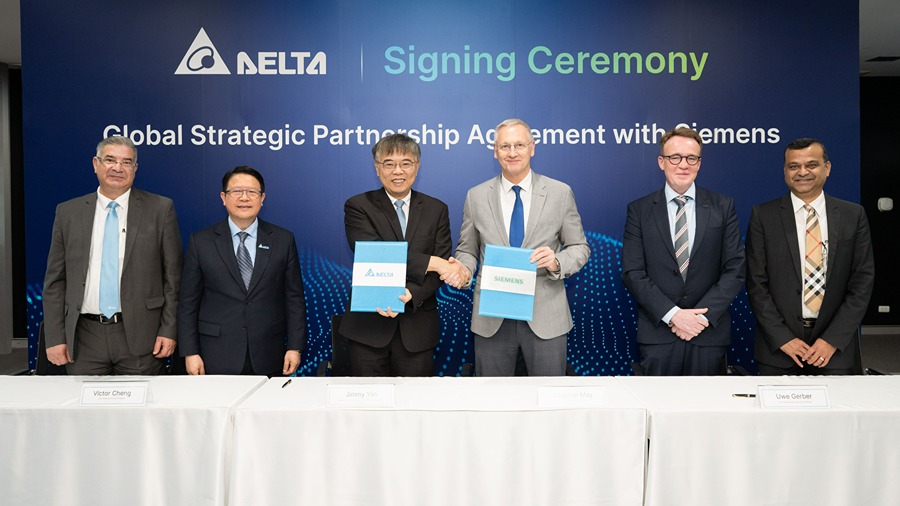
ZUG, Switzerland, Nov 19, 2025 – Siemens Smart Infrastructure and Delta established a global partnership to deliver prefabricated, modular power solutions for data centers. The systems are built to shorten deployment schedules and lower capital costs for hyperscale and colocation operators expanding capacity for AI and cloud computing workloads.
Data-center operators face tight timelines, rising costs and sustainability requirements as they scale infrastructure. The prefabricated power solutions from Siemens and Delta provide a predictable path for deploying new capacity.
Jimmy Yiin, executive vice president of global business operations, Delta Electronics said: “Delta’s commitment to energy efficiency is foundational to this agreement. By leveraging our expertise in power solutions from grid to chip, which enables us to architect the system closer to the critical load, our Uninterruptible Power Supply (UPS), batteries, and advanced thermal management technologies are uniquely designed for the high-density demands of the AI era. Working with Siemens allows us to further expand the reach of our cutting-edge, energy-saving solutions rapidly through a single, globally supported supply chain across EMEA and APAC.”
The agreement centers on the delivery of prefabricated, containerized power systems (SKIDs, eHouses). These systems are built and tested off-site and use a standardized layout for installation. This approach is designed to shorten deployment schedules, reduce construction risk and improve use of data-center space. The design may lower capital costs by up to 20% and carbon emissions by up to 27% by reducing concrete use.
“Our partnership with Delta represents an important milestone for data center construction in the world’s fastest-growing markets,” said Stephan May, CEO of electrification & automation at Siemens Smart Infrastructure. “By combining Siemens’ electrical power distribution and engineering services with Delta’s high-efficiency UPS, battery and cooling offerings, together we are delivering a prefabricated, customizable solution that can drastically cut time-to-market by up to half. This approach also lowers construction risk with better predictability, while enhancing energy efficiency and supporting the long-term sustainability goals of our customers.”
Designing the power systems with Building Information Modeling (BIM) from the start integrates real-time data from all components, including third-party equipment, into the building management system. This setup supports faster troubleshooting, efficient operations and long-term performance. The digital model also speeds installation and manage the data center’s energy use. The virtual layout improves planning, supports collaboration and helps identify issues before construction begins.
Siemens works with partners whose technology aligns with its own systems and expertise. This approach supports interoperability across the data-center value chain and helps address operational and infrastructure needs that require coordinated solutions.
Source: Siemens
About Siemens Smart Infrastructure

Siemens Smart Infrastructure, a division of Siemens AG, is headquartered in Zug, Switzerland. The division integrates energy systems, buildings and industrial processes to improve efficiency and support modern infrastructure needs. It provides HVAC controls, fire safety systems, security technologies, energy-performance services, grid-resilience tools and electric-vehicle charging equipment. Its offerings serve sectors such as data centers, energy and manufacturing. The division develops systems that span the energy value chain, from power generation to end use, and focuses on addressing challenges related to urbanization and climate change. It also places emphasis on cybersecurity to support secure and reliable operation in increasingly digital environments. Siemens Smart Infrastructure employed about 79,000 people worldwide as of 2025.
About Siemens AG
Siemens AG, headquartered in Munich and Berlin, Germany, is a global technology company focused on industry, infrastructure, mobility and healthcare. Founded in 1847, the company develops industrial automation systems, digitalization technologies, energy-efficient equipment and medical diagnostic systems. Siemens applies industrial and generative AI to improve efficiency and operational performance across manufacturing, infrastructure and transportation. Its work combines physical systems with digital tools to support industrial processes, smart infrastructure and connected mobility. Siemens holds a majority stake in Siemens Healthineers, a medical technology company specializing in diagnostics and healthcare systems. The company is a major employer with more than 300,000 people worldwide and has significant operations in Germany.
About Delta Electronics

Delta Electronics develops power management and thermal solutions for use in data centers, telecommunications, automotive systems and industrial automation. Founded in 1971, the company is headquartered in Taipei City, Taiwan. Its products include switching power supplies, cooling fans, thermal management systems, industrial automation equipment, data center infrastructure, renewable energy systems and electric-vehicle charging stations. The company serves enterprise customers, original-equipment manufacturers and system integrators across sectors such as manufacturing, renewable energy, smart buildings and electric-vehicle infrastructure. Delta supports applications that range from data-center power distribution to automotive electronics and industrial control systems. The company operates more than 200 facilities worldwide, including manufacturing plants, research centers and sales offices. Its global workforce includes approximately 81,000 to 83,000 employees. Delta sells its products through a network of regional offices and distributors and provides solutions used in industrial automation, power conversion, thermal management and energy-related systems.
