

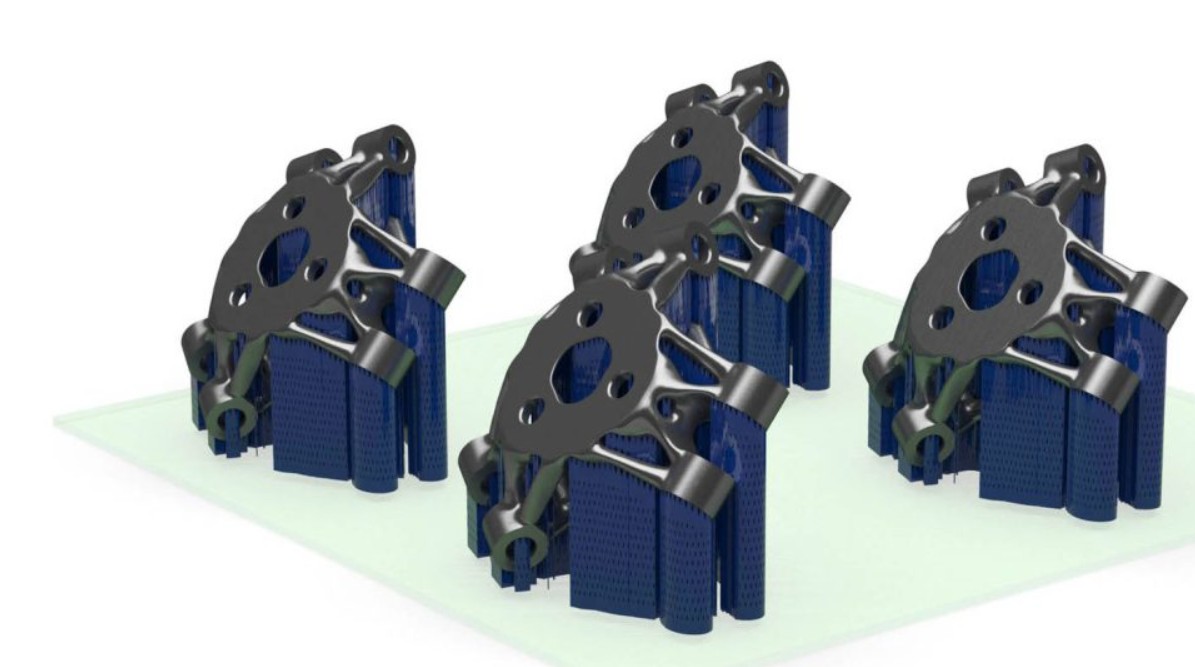
Siemens is strengthening its position in additive manufacturing (AM) by integrating design, simulation, production preparation, and post-processing within a unified engineering environment. Develop 3D examines the company’s strategy to compete with specialist 3D printing software providers by drawing on its extensive industrial manufacturing expertise.
Through its Designcenter platform, Siemens aims to make additive manufacturing considerations more accessible during early product development. Its expanding capabilities enable engineers to move from initial CAD models through design validation, manufacturing simulation, and production preparation without switching between disconnected applications.
Artificial intelligence (AI) plays an increasingly important role in these workflows. Rather than relying exclusively on equipment manufacturers’ standard calculations, NX AM generates build-time predictions tailored to individual machines, materials, and production configurations. Learning from previous builds helps improve estimates of production duration, energy consumption, and manufacturing costs.
For additive manufacturing service providers, these capabilities could accelerate quotation processes and improve production planning.
Another significant development is the integration of additive and subtractive manufacturing. AI-assisted feature recognition supports automated preparation for support removal, drilling, milling, and surface finishing. Associative engineering data also ensures that design modifications propagate throughout subsequent manufacturing operations.
Siemens’ token-based subscription model introduces additional flexibility, allowing engineering teams to access specialized additive manufacturing tools when required rather than maintain dedicated annual licenses for every user.
Advanced multiphysics simulation capabilities address thermal distortion, material shrinkage, and potential printing failures, although these require separate licensing. Siemens also anticipates expanding its design and simulation capabilities through the ongoing integration of Altair technologies.
For engineering teams, this approach could reduce software fragmentation, repetitive manual work, and production preparation errors. It also highlights a broader shift toward treating additive manufacturing as an integral part of industrial production rather than an isolated fabrication process.
Siemens’ expanding software ecosystem could consequently intensify competition among specialist AM software developers while encouraging wider adoption of integrated digital manufacturing workflows.
