

 Several thousand hardcore engineers filed into the Realize LIVE 2026, again at the Huntington Convention Center in Detroit, mercifully at 4 pm local time today. It had been a redeye flight for me that left me in no shape for an earlier keynote.
What Siemens served up over the next 80 minutes was less product announcement, as conferences are wont to be, than a strategic argument: that the era of industrial AI has arrived, and that only companies with a comprehensive digital foundation are equipped to take advantage of it.
Tony Sets the Frame
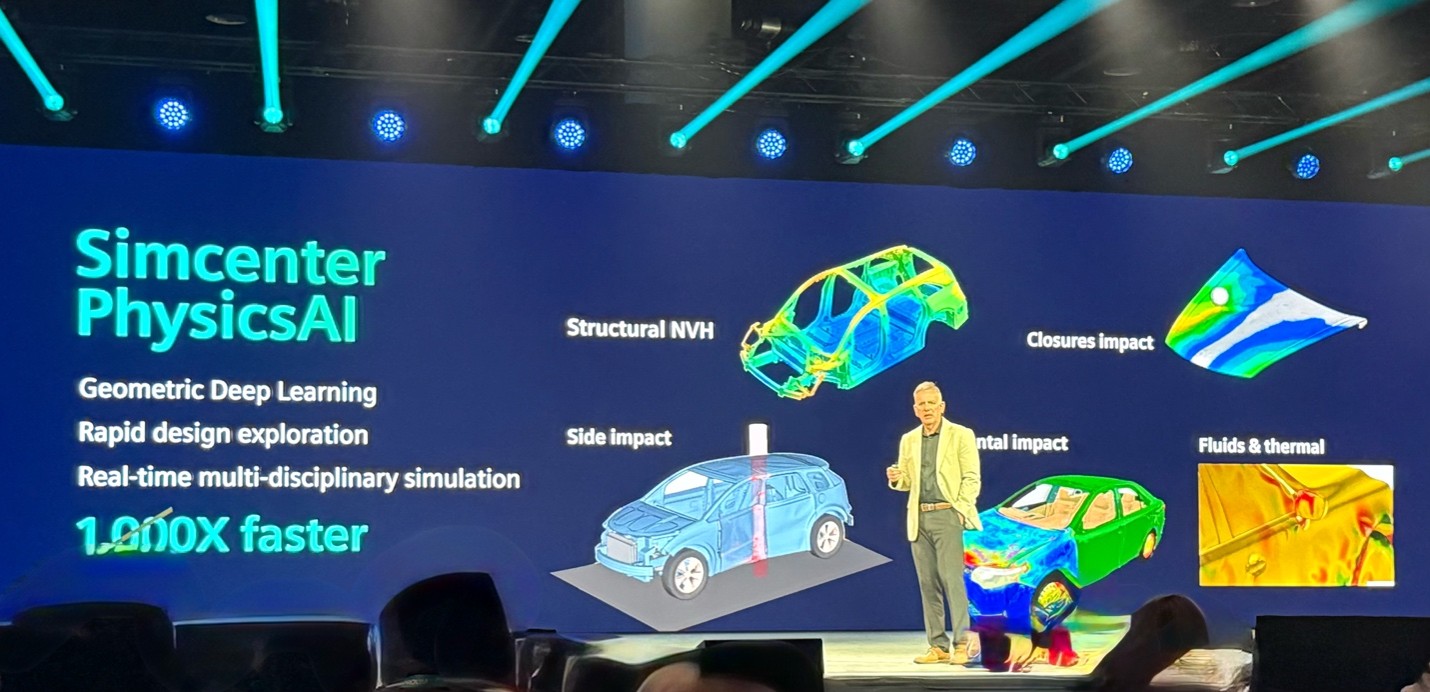
Tony Hemmelgarn, CEO of Siemens Digital Industries Software, took early command of the stage with, of all things, wildfires.
“Wildfires don’t just burn trees, they threaten families, firefighters — they never stand still. The wind turns without warning. The heat builds, humidity vanishes. A perimeter that was once safe becomes a trap.”
His point: modern manufacturing operates in the same conditions. Supply chains fracture. Regulations shift overnight. A material disappears and suddenly a factory has to move. In that environment, he argued, a static plan is a liability. What companies need is a plan that can change the moment reality changes.
From there, Hemmelgarn walked the audience through what Siemens calls Industrial Intelligence — a three-part framework built around comprehensive digital twins, lifecycle intelligence, and adaptive execution. None of it was new branding exactly, but the emphasis on AI grounded in physics rather than statistics was pointed.
“AI only works if you’re built on engineering truth. It’s got to be grounded in how the products actually function — not statistical guesses.”
That line is doing real work. Siemens is drawing a hard line between what it considers trustworthy AI — physics-based, simulation-validated, connected to managed PLM data — and the probabilistic outputs of general-purpose large language models. The implicit target is obvious, even if the competitor names went unspoken.
The Chip Problem and the Speed Solution
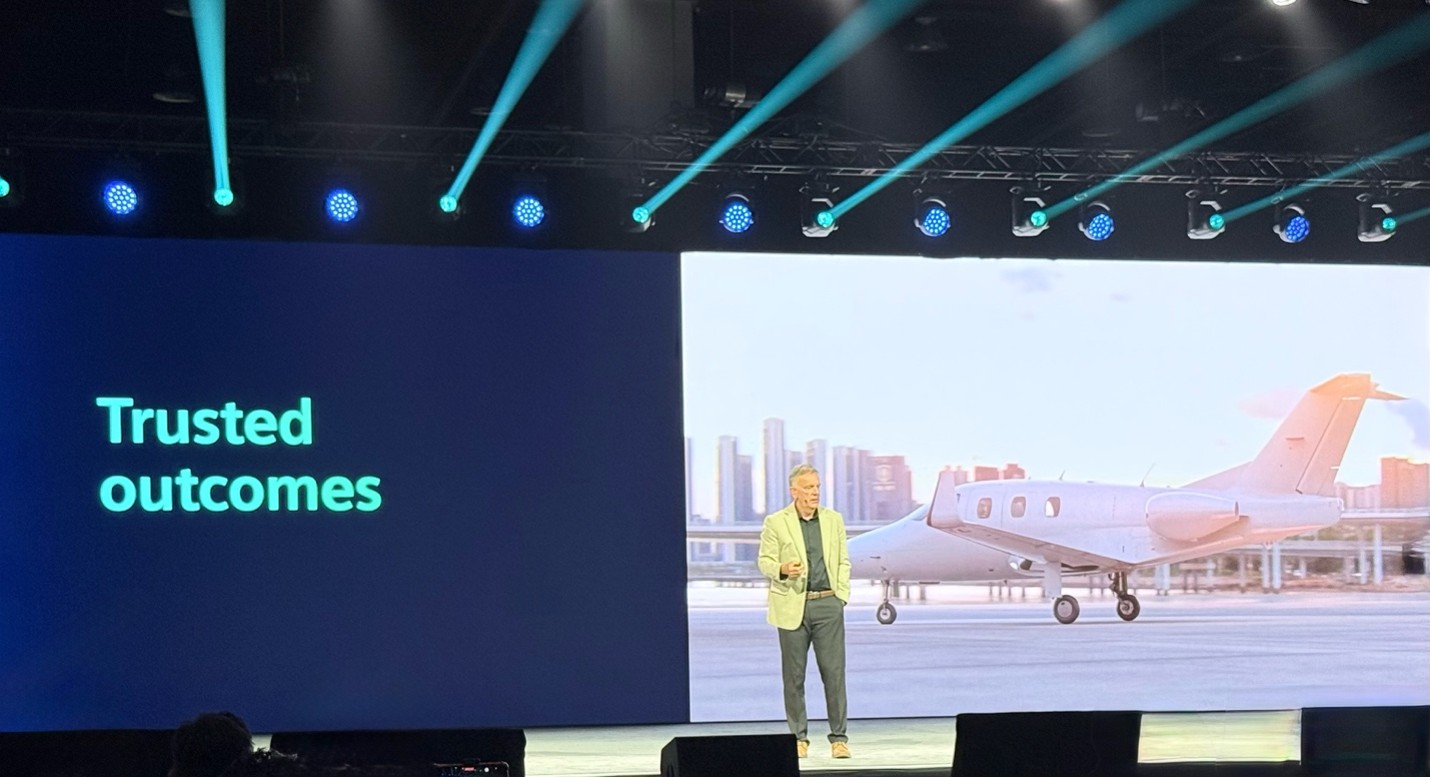
Hemmelgarn spent considerable time on electronic design automation, specifically the verification challenge posed by modern semiconductors. A contemporary NVIDIA GPU contains 200 billion transistors — roughly the number of stars in the Milky Way, he noted — and whether they work without faulting had been, previous to AI, thousands of hours of testing or somebody’s best guess. “If you miss a failure mode in the design of that chip, the cost is enormous. So your verification becomes the bottleneck.”
Siemens’ answer is Solido, a product that uses AI to narrow the variation space so compute is focused where it matters. The result, Hemmelgarn claimed, is verification seven times faster without sacrificing accuracy — and when the software runs on GPUs, that timeline can compress further, from weeks to hours.
He also previewed Intelligence Center Max, described as a natural-language interface for chip design workflows. The pitch: a junior engineer describes what they want, and the system sets it up — no menus, no manual configuration. Whether that claim survives contact with actual chip designers is a different question, but the direction is clear.
The Data Problem Nobody Wants to Talk About
The problem with AI these days is its inherent unreliability. ChatGPT, Gemini, Claude… all source publicly available information wherever it might exist.
He described being on a panel with two customer CEOs when the topic of AI data sourcing came up. One said the last thing he needed was for AI to pull a 20-year-old document from a SharePoint drive. The CEO sitting next to him had a sharper reaction.
“If you did that in my company today, my factory would burn down because of the data that’s there.”
Hemmelgarn’s response is Teamcenter — Siemens’ PLM application. It’s not just a product lifecycle management tool but as the trusted data foundation that makes AI decisions reliable. The argument is that 51% of engineering data still sits on desktops, particularly at small and mid-sized businesses, and that without structured, connected data, AI is either inert or dangerous.
The company recently released Teamcenter Apps specifically to address the small-to-medium business segment — a cloud-delivered version that Siemens runs on the customer’s behalf, removing the infrastructure burden and bringing those companies up to speed with AI.
Pepsi Builds a Factory It Never Touched
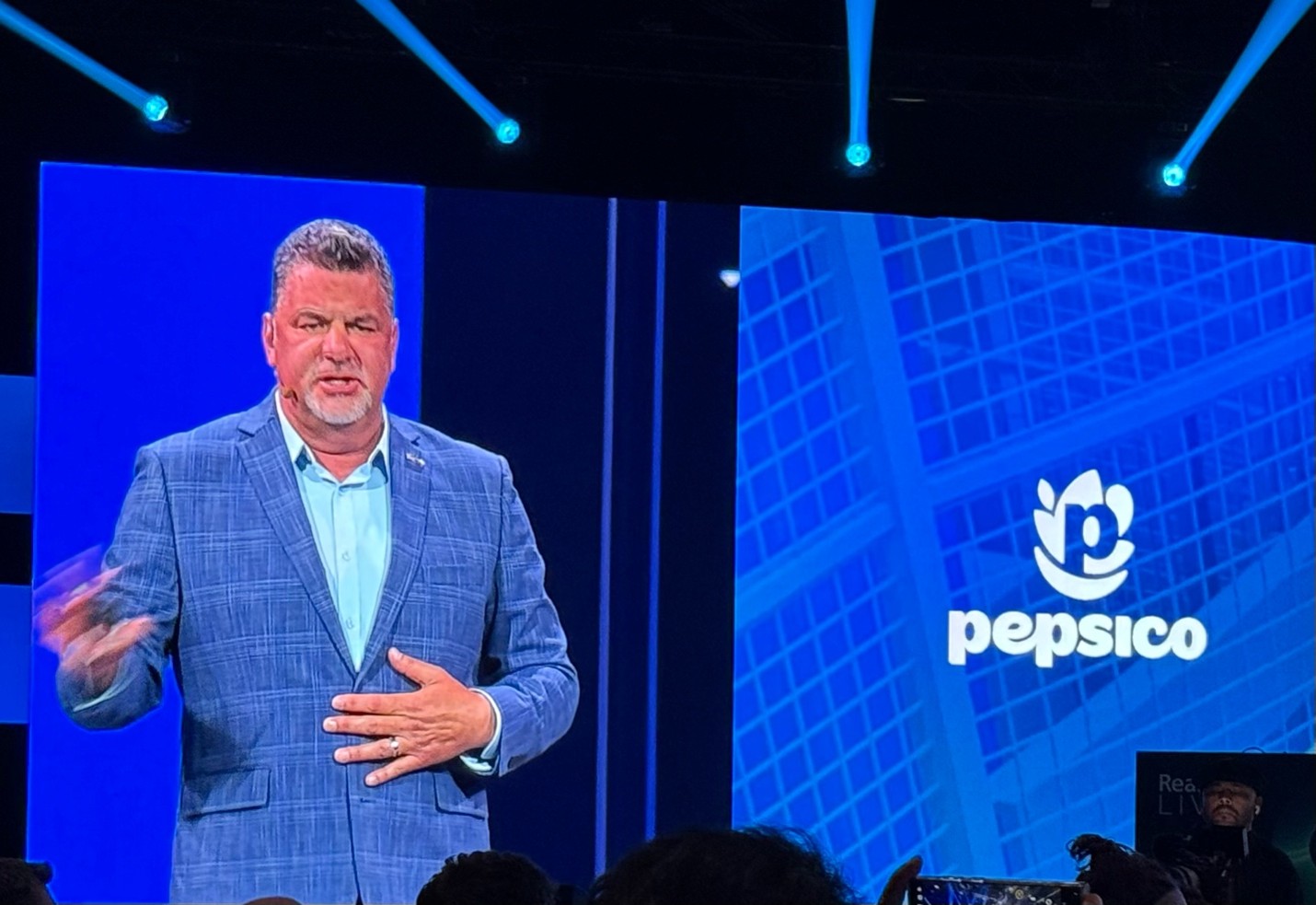
The customer keynote came from Stephen Hoinka, who leads global manufacturing strategy for PepsiCo. Stephen is not far from home. He grew up fifteen minutes from the convention center.
“For 30-plus years of my life I got to represent the 313 — so it’s really great to come home.”
The 313, for those not from Detroit, is the city’s area code.
Hoinka’s story was about a pilot project: two brownfield manufacturing facilities — one beverage, one snacks — that PepsiCo wanted to combine into a single operation, routing product through a new mixing center. The challenge was doing it without spending months on physical trials and rework.
They needed to do it in 12 weeks. What followed was 3D scans of the existing facilities, simulation of every flow and capacity variable from raw material intake to downstream distribution, and scenario testing across the entire network. Hoinka walked through the methodology step by step.
“Capital decisions must be based on reality. Now, that could be digital reality — and that’s more what I’m talking about. But even when dealing with multiple brownfield locations, the digital twin really unveiled flow opportunities and spatial opportunities, things that we were not expecting to see.”
PepsiCo had already implemented an auto trailer loading system at another facility using traditional planning methods, giving up six dock doors in the process. Running the same problem through the digital twin produced a redesigned solution that required only three dock doors and was cheaper to implement. The company plans to retrofit the original installation.
The numbers Hoinka cited were notable: 20% throughput improvement across the end-to-end value chain, 90%-plus of potential operational issues avoided through virtual discovery, and significant capital expenditure reduction. He put a ceiling on his own optimism.
“This is a little conservative. It doesn’t take into consideration the potential for plant consolidation, or cap avoidance. I don’t need to build a new building — I can put a new line in existing brick and mortar.”
“Think big, start small, go fast. And don’t wait for perfect data conditions before getting started.”
What Keeps the Industry Up at Night
After Hoinka’s presentation, Edholm asked him what separates a successful AI pilot from one that stays a pilot.
“There’s two components of AI that keep me up at night. One is data — are you sourcing data that’s accurate, is it maintained, is it going to deliver a response that is going to be usable? I can’t have somebody ask the system a question that tells them how to do something wrong and then you have an industrial accident, a quality complaint downstream. The quality of information that AI is sourcing absolutely terrifies me.”
The second concern was the opposite problem: speed. Employees are already using Claude, ChatGPT, and Gemini in their personal lives, Hoinka said, and they expect the same ease of use inside the enterprise.
“We can’t go fast enough. That’s probably a bigger issue. If you have the right use cases, you can make sure the data and the library you’re accessing have great information. Go as fast as you can, keep your foot on the accelerator, because I don’t think we can keep up.”
Excellence Awards
The keynote closed with the third annual Excellence Awards, which Siemens uses to honor customers doing interesting things with its technology. This year’s categories: Community Champion, Innovation Leader, Sustainability Impact, Digital Transformation, and — new for 2026 — Responsible AI.
That PepsiCo won the Innovation Leader award was no big surprise. They had only been Siemens’ poster child minutes ago. They were recognized for leading PepsiCo’s digital twin collaboration with Siemens and Nvidia. The Digital Transformation award went to Vivix, a Brazilian glass manufacturer that has deployed ten AI agents and is building toward autonomous operations.
The Responsible AI award went to Lucid Motors for integrating AI into crash safety design with mandatory human validation checkpoints.
The Responsible AI category signals something about where the industry’s anxiety has moved. A year or two ago, the conversation was about whether AI would deliver. Now the conversation is about whether it will be trusted — and by whom, and under what conditions.
Siemens came to Detroit with a clear message: industrial AI is trustworthy.
The comprehensive digital twin argument is not new. Siemens has been making it for years. What’s different in 2026 is the pressure behind it. Generative AI has raised expectations across the enterprise, and the industrial software vendors that can connect AI output to physics-validated, PLM-managed, configuration-controlled data have a credible story. The ones that can’t are going to have a harder time explaining why their AI should be trusted with a factory floor.
As Hemmelgarn put it near the end of his keynote, summarizing the whole framework in a single line:
“Complexity isn’t risk — it’s a competitive advantage. Because you can go so much quicker through this process.”
That’s the bet. Complexity can be managed — with industrial AI.
