

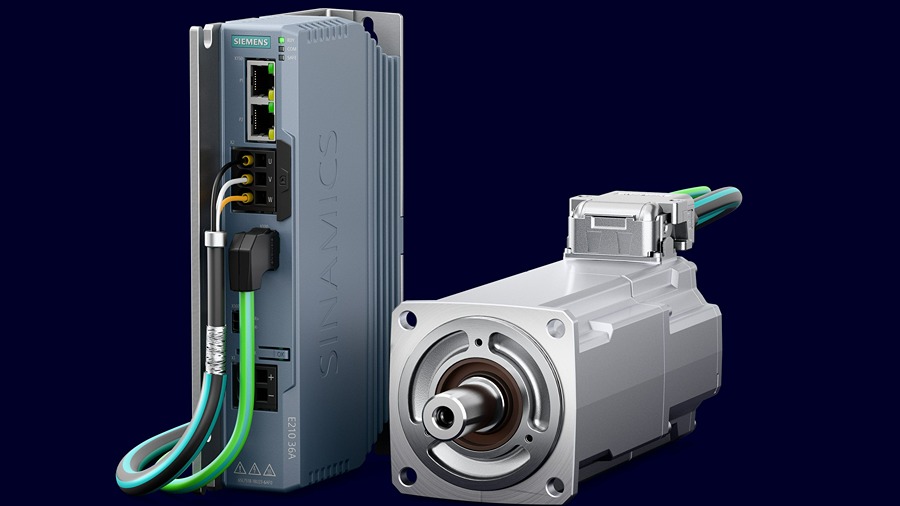
ERLANGEN, Germany, Nov 4, 2026 – Siemens has introduced the Sinamics E210 converter and Simotics E-1EE1 servomotors as an integrated extra-low-voltage (ELV) drive solution for battery-powered mobile systems. Designed for 24 V and 48 V applications, the components support automated guided vehicles (AGVs), autonomous mobile robots (AMRs) and driverless transport systems.
The Sinamics E210 is a regenerative converter that provides precise control of traction and wheel drives, steering, lifting and auxiliary motion axes. It connects to ELV battery systems, streamlining system architecture and improve energy efficiency.
The Sinamics E210 includes safety functions, PROFIsafe support and PROFINET IRT communication. Integration with TIA Portal and Simove modular system supports its incorporation into higher-level automation and vehicle designs. The Sinamics E210 also features high overload capability and flexible installation options.
The Simotics E-1EE1 servomotors extend Siemens’ ELV motor portfolio into higher power and torque ranges, with shaft heights from 40 to 63. Designed for 24 V and 48 V operation, the motors are matched to the Sinamics E210 for dynamic mobile applications.
A 14-bit BiSS-C safety encoder and dual-channel design support safety-related applications up to Safety Integrity Level (SIL) 2. An electronic nameplate allows the converter to read relevant motor data, simplifying parameterization and commissioning. The motors also offer optional holding brakes, multiple gearbox options and connection technology.
Siemens developed the drive solution to help manufacturers and system integrators reduce development effort and simplify the implementation of safety concepts. The integration of drive components, safety functions and automation tools is meant to reduce integration risks and support a system architecture for future automation, safety and cybersecurity requirements.
Source: Siemens
About Siemens AG

Siemens AG is a technology company founded in 1847 and headquartered in Munich and Berlin, Germany. The company develops products and services in industrial automation, electrification, digital systems, and mobility. Its offerings include automation systems, industrial software, building technologies, rail transport systems, and power distribution solutions. Siemens also provides financial services and supports infrastructure projects. It serves industries such as manufacturing, energy, transportation, construction, and healthcare. The company works with enterprises, utilities, governments, and infrastructure operators worldwide. Siemens operates in more than 190 countries. It applies digital tools and AI to industrial and infrastructure use cases. Siemens holds a majority stake in Siemens Healthineers, a publicly listed healthcare technology company. Siemens has about 318,000 employees globally.
About Siemens Digital Industries

Siemens Digital Industries (DI), a division of Siemens AG, focuses on industrial automation and digitalization. Based in Nuremberg, Germany, the division provides software, automation systems, and digital services that support the full product and production lifecycle—from design and engineering to manufacturing and maintenance. With a history extending over six decades, Siemens DI serves key sectors including automotive, aerospace, pharmaceuticals, energy, and electronics. Its technologies, such as the Xcelerator platform and SIMATIC automation systems, are designed to integrate physical and digital processes, enabling data-driven manufacturing and operational efficiency. The division reports annual revenues exceeding €18 billion and employs approximately 70,000 people globally. Its portfolio supports manufacturers in implementing Industry 4.0 strategies by linking simulation, automation, and real-time data in scalable systems.
