

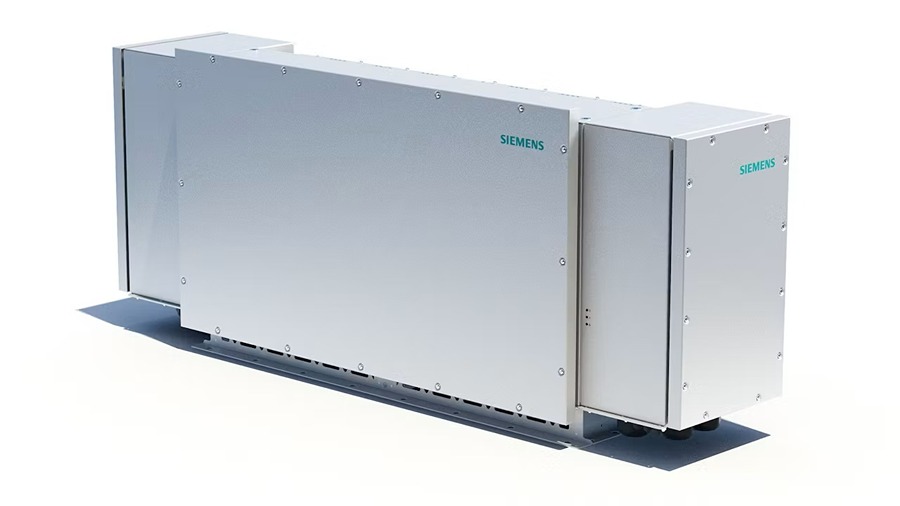
LAS VEGAS, NV, Nov 20, 2026 – Siemens has introduced WATTBLOC, a solar power conversion platform combining the WATTBLOC 500 string inverter with a modular virtual central station architecture. The system integrates multiple inverter modules with AC switchgear and medium-voltage transformation, supporting project configurations starting at 1 MW and up to 5 MWac.
Designed for photovoltaic installations, WATTBLOC allows utilities, developers, engineering, procurement and construction (EPC) contractors, and asset owners to configure power conversion systems according to project requirements.
The WATTBLOC 500 is a string inverter with single maximum power point tracking (MPPT). It supports multiple AC voltage configurations from 370 V to 800 V, with power ratings ranging from 227 kVA to 500 kVA.
The WATTBLOC 500 incorporates silicon carbide technology, active cooling and a single-stage topology. Siemens reports efficiency of up to 99.2%. The company describes the inverter as NEMA 4X- and IEEE 2800-compliant. The WATTBLOC 500 can operate as a stand-alone unit or as part of a WATTBLOC virtual central station.
Modular Power Conversion and Maintenance
The WATTBLOC distributes power conversion across multiple independent string inverter modules. Operators can isolate individual modules for servicing while the remaining capacity continues operating. According to Siemens, the distributed power conversion and control architecture provides redundancy, reduces downtime exposure during maintenance and supports higher overall plant availability.
“Utility-scale solar should not require customers to choose between flexibility, scalability and reliability,” said Dave Pisano, head of utility systems and solutions for electrification and automation at Siemens Smart Infrastructure USA. “We designed WATTBLOC around a fundamentally different idea: make the power-conversion building block smaller, independent and incredibly flexible, and then allow customers to deploy it in the configuration that makes the most sense for their site. That combination of agility, modularity and redundancy gives customers a powerful platform for improving availability, simplifying maintenance and scaling their solar assets over time.”
The platform uses power blocks that combine inverter modules, AC switchgear and medium-voltage transformation. Developers can add these modular blocks as solar installations expand.
Source: Siemens
About Siemens

Siemens Corporation, the U.S. subsidiary of Siemens AG, operates across industry, infrastructure, transportation, and healthcare sectors. Founded in 1847, Siemens AG has more than 175 years of history and is headquartered in Munich, Germany. Its U.S. operations are based in Washington, D.C. The company maintains 24 manufacturing sites in the United States and employs over 50,000 people, serving customers in all 50 states and Puerto Rico. Siemens focuses on integrating digital and physical technologies to support customer needs in efficiency, urban development, and sustainable transportation. The company applies industrial AI – including generative AI – to use cases across sectors.
About Siemens Smart Infrastructure
Siemens Smart Infrastructure, a division of Siemens AG, is headquartered in Zug, Switzerland. The division integrates energy systems, buildings and industrial processes to improve efficiency and support modern infrastructure needs. It provides HVAC controls, fire safety systems, security technologies, energy-performance services, grid-resilience tools and electric-vehicle charging equipment. Its offerings serve sectors such as data centers, energy and manufacturing. The division develops systems that span the energy value chain, from power generation to end use, and focuses on addressing challenges related to urbanization and climate change. It also places emphasis on cybersecurity to support secure and reliable operation in increasingly digital environments. Siemens Smart Infrastructure employed about 80,000 people.
