

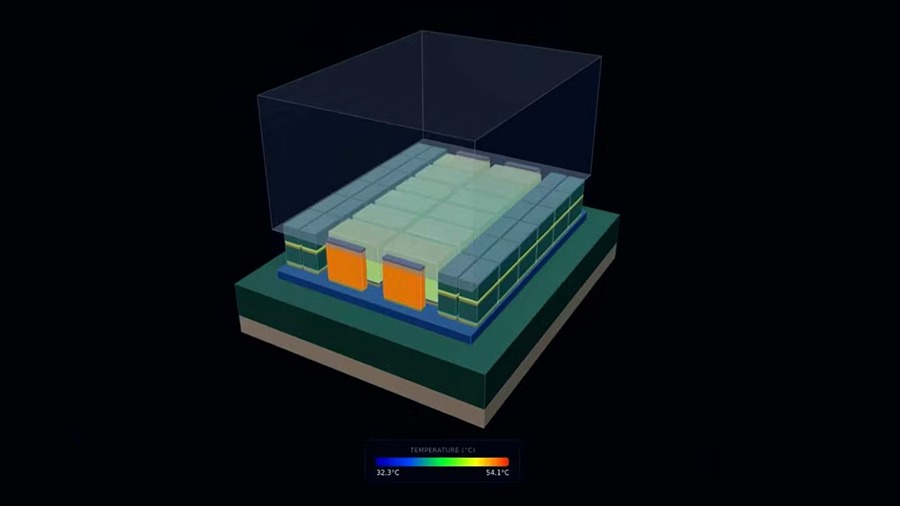
PLANO, TX, Oct 23, 2026 – Siemens has expanded its EDA portfolio with an AI agent workflow that coordinates electrical, power and thermal analysis for 3D integrated circuits. Developed in collaboration with NVIDIA, the workflow connects seven Siemens tools to evaluate design alternatives against engineering targets.
An engineer defines the objective, and Siemens’ Fuse EDA AI Agent, integrated with Intelligence Center X, runs electrothermal analyses. The Fuse EDA AI agent identifies missed targets and diagnoses whether power delivery, placement, materials or a combination of those factors caused them. It uses the results to guide design exploration and rerun configurations.
Conventional workflows require specialists to coordinate tools and transfer data between electrical, power, thermal and extraction analyses. Repeated manual iterations, alongside time and computing constraints, can limit the number of scenarios engineers evaluate.
The new workflow combines self-verifying agent capabilities introduced at DAC 2026 with NVIDIA accelerated computing and Siemens’ Design Space Exploration and Optimization technology. Engineers can evaluate and validate hundreds of alternatives using signoff-grade, physics-based solvers.
In benchmark studies, Siemens reports:
- Up to 95% less effort, reducing a process that took multiple weeks to hours
- Up to 99% less workflow setup time, less than five minutes compared with several days across seven tools.
- Up to 50 times greater design exploration coverage compared with conventional manual workflows.
“Electrothermal codesign has traditionally required experts to coordinate multiple tools and manually iterate through a limited set of design alternatives,” said Ankur Gupta, executive vice president, EDA IC portfolio, Siemens. “By combining agentic AI with Siemens’ proven physics-based analysis, engineers can now evaluate up to 50 times more design scenarios, enabling faster and more confident decisions for the next generation of AI infrastructure.”
“Power delivery and heat dissipation increasingly determine what’s possible in 3D chip design,” said Tim Costa, vice president and general manager of industrial and computational engineering at NVIDIA. “With NVIDIA Agent Toolkit and Nemotron-3.5-Lightning, Siemens’ agents coordinate electrical and thermal solvers to deliver up to 50x greater coverage in design space exploration with 95% less engineering effort. By diagnosing how power delivery, die placement and package materials contribute to missed targets, these agents make electrothermal analysis an integral part of chip development.”
Seven-Tool Analysis Workflow
Siemens tools cover design, power calculation, thermal analysis, extraction and electrical simulation:
- Innovator3D IC Integrator: Floor planning and complete 3D IC assembly and package design.
- Solido Characterizer: AI-powered library characterization to generate Liberty files.
- mPower Digital: Power analysis and temperature-dependent instance power calculation.
- Calibre 3DThermal: 3D IC thermal signoff and power mapping.
- Simcenter Flotherm: System-level thermal simulation and visualization.
- Calibre xACT: Temperature-dependent parasitic extraction.
- Solido SPICE: AI-accelerated power- and temperature-aware electrical SPICE simulation.
NVIDIA Software Supports Agent Execution
Siemens combines NVIDIA Agent Toolkit, accelerated computing and CUDA-X libraries to support the workflow. The company says faster solver results help agents evaluate more design scenarios within the available time.
The NVIDIA components include:
- Nemotron open models: Orchestrate and execute agent-driven EDA subflows.
- NeMo Gym: Tracks agent trajectories and identifies areas for refining agent skills and MCP tool descriptions.
- NeMo RL: Supports post-training fine-tuning of cost-efficient large language models with domain-specific EDA knowledge and proficiency in calling EDA tools.
- NeMo Relay: Provides observability and auditability across agent harnesses.
- NeMo Switchyard: Routes tasks to balance accuracy, computing resource utilization and token cost.
- NVIDIA OpenShell: Sandboxes agent execution to protect sensitive intellectual property and foundry PDKs.
- NVIDIA CUDA-X libraries: Accelerate supported engineering solvers used by the agents, reducing simulation wait times during iterative design workflows.
Siemens says the workflow coordinates nine steps across the seven analysis tools, executing 50 to 100 reasoning steps over an eight- to 10-hour runtime. Each cycle can evaluate 200 to more than 500 design points, varying heat transfer coefficient boundaries, power budgets and material stack-ups.
Source: Siemens
About Siemens

Siemens AG is a technology company founded in 1847 and headquartered in Munich and Berlin, Germany. The company develops products and services in industrial automation, electrification, digital systems, and mobility. Its offerings include automation systems, industrial software, building technologies, rail transport systems, and power distribution solutions. Siemens also provides financial services and supports infrastructure projects. It serves industries such as manufacturing, energy, transportation, construction, and healthcare. The company works with enterprises, utilities, governments, and infrastructure operators worldwide. Siemens operates in more than 190 countries. It applies digital tools and AI to industrial and infrastructure use cases. Siemens holds a majority stake in Siemens Healthineers, a publicly listed healthcare technology company. Siemens has about 318,000 employees globally.
About Siemens Digital Industries Software

Siemens Digital Industries Software, a business unit of Siemens AG, provides industrial software, hardware and related services through the Siemens Xcelerator platform. The company’s portfolio includes product lifecycle management, electronic design automation, simulation and digital twin tools, manufacturing operations management and low-code application development. These products support design, engineering and production workflows across sectors such as aerospace and defense, automotive, electronics and semiconductors, machinery, medical devices and process manufacturing. Siemens Digital Industries Software traces its origins to 1963 as United Computing, later becoming Siemens PLM Software in 2007 before adopting its current name. It supplies technologies that help organizations manage product, process data, and improve development and manufacturing efficiency across a range of industrial applications.
About NVIDIA

NVIDIA, founded in 1993 and headquartered in Santa Clara, CA, designs and manufactures graphics processing units, systems on chips, networking hardware, and AI intelligence software such as CUDA. Its products serve industries including gaming, data centers, autonomous vehicles, professional visualization, robotics, health care, and energy. The company introduced the GPU in 1999 and later expanded into accelerated computing and AI infrastructure. In gaming, its GPUs support high-performance rendering, while in AI and high-performance computing, its systems provide the infrastructure for training and deploying large-scale models. NVIDIA also develops tools for robotics and autonomous driving.
