

PLANO, TX, Oct 26, 2026 – Siemens and NVIDIA are developing a workflow that prepares printed circuit board (PCB) inspection using digital twins and synthetic images before physical boards are produced. The companies are demonstrating the approach at Siemens Electronics Factory in Erlangen, Germany.
The workflow connects Siemens’ Teamcenter PLM software and Process Preparation X with NVIDIA Cosmos to prepare automated optical inspection (AOI) processes.
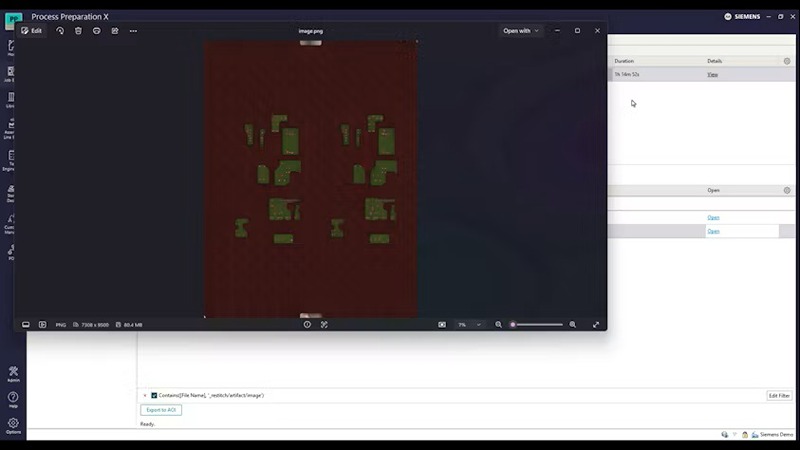
Teamcenter supplies PCB design, bill of materials (BoMs) and component information. Process Preparation X validates, normalizes and assembles that information into a digital twin of the printed circuit board assembly (PCBA).
Siemens uses this reference-board digital twin with NVIDIA Cosmos to create a photorealistic virtual golden board and synthetic images of good and defective boards. NVIDIA Cosmos Data Factory generates defect images for inspection-machine calibration before physical boards are produced.
“By connecting the comprehensive Digital Twin to the shop floor and AI we are improving both line productivity and product quality. At the Erlangen factory, we’re demonstrating how the deterministic nature of Siemens’ Digital Twin is the foundation for leveraging physics AI for preparing production,” said Mark Hindsbo, executive vice president operations software, Siemens. “By leveraging a ‘virtual’ golden board, electronics manufacturers can change production dramatically quicker without taking the line out of production. This enables electronics manufacturers to respond more quickly to change and helps reach production readiness at scale and speed – while helping to reduce manual engineering effort, accelerate AOI readiness and improve manufacturing quality.”
“Manufacturers shouldn’t have to wait for the first physical circuit board to start preparing inspection,” said Rev Lebaredian, vice president, Physical AI Simulation at NVIDIA. “By combining Siemens’ industrial software and manufacturing expertise with NVIDIA Cosmos, we can generate synthetic images of good and defective boards to prepare inspection virtually—helping manufacturers bring new products into production faster.”
Inspection Support During Production
The workflow also includes an AI-supported secondary inspection capability. When an AOI system flags a potential defect, the AI capability can help determine whether the condition represents a real defect or a false call.
Siemens and NVIDIA intend to connect virtual inspection preparation and calibration with inspection support once production begins. The stated goals includes relying less on physical samples and manual verification.
Erlangen Demonstration Targets
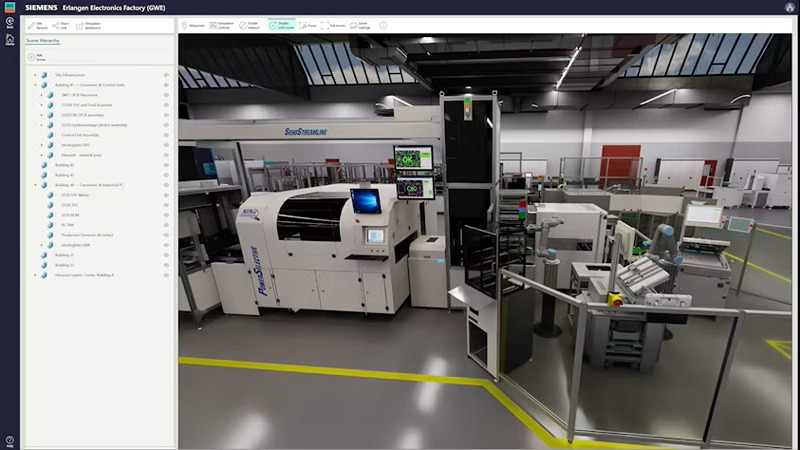
The Erlangen factory serves as Siemens’ Customer Zero for the work on adaptive, autonomous and AI-powered production. It provides the manufacturing use case, production environment and subject-matter expertise in a high-mix setting with changing processes.
The project targets:
- Up to 85% less manual engineering effort in AOI program generation.
- 40% fewer false calls.
- More than 5% improvement in first-pass yield.
The goal is to introduce production changes 3 – 5 times a week without disruption.
Source: Siemens
About Siemens Digital Industries Software

Siemens Digital Industries Software, a business unit of Siemens AG, provides industrial software, hardware and related services through the Siemens Xcelerator platform. The company’s portfolio includes product lifecycle management, electronic design automation, simulation and digital twin tools, manufacturing operations management and low-code application development. These products support design, engineering and production workflows across sectors such as aerospace and defense, automotive, electronics and semiconductors, machinery, medical devices and process manufacturing. Siemens Digital Industries Software traces its origins to 1963 as United Computing, later becoming Siemens PLM Software in 2007 before adopting its current name. It supplies technologies that help organizations manage product, process data, and improve development and manufacturing efficiency across a range of industrial applications.
About Siemens AG

Siemens AG is a technology company founded in 1847 and headquartered in Munich and Berlin, Germany. The company develops products and services in industrial automation, electrification, digital systems, and mobility. Its offerings include automation systems, industrial software, building technologies, rail transport systems, and power distribution solutions. Siemens also provides financial services and supports infrastructure projects. It serves industries such as manufacturing, energy, transportation, construction, and healthcare. The company works with enterprises, utilities, governments, and infrastructure operators worldwide. Siemens operates in more than 190 countries. It applies digital tools and AI to industrial and infrastructure use cases. Siemens holds a majority stake in Siemens Healthineers, a publicly listed healthcare technology company. Siemens has about 318,000 employees globally.
About NVIDIA

NVIDIA, founded in 1993 and headquartered in Santa Clara, CA, designs and manufactures graphics processing units, systems on chips, networking hardware, and AI intelligence software such as CUDA. Its products serve industries including gaming, data centers, autonomous vehicles, professional visualization, robotics, health care, and energy. The company introduced the GPU in 1999 and later expanded into accelerated computing and AI infrastructure. In gaming, its GPUs support high-performance rendering, while in AI and high-performance computing, its systems provide the infrastructure for training and deploying large-scale models. NVIDIA also develops tools for robotics and autonomous driving.
