

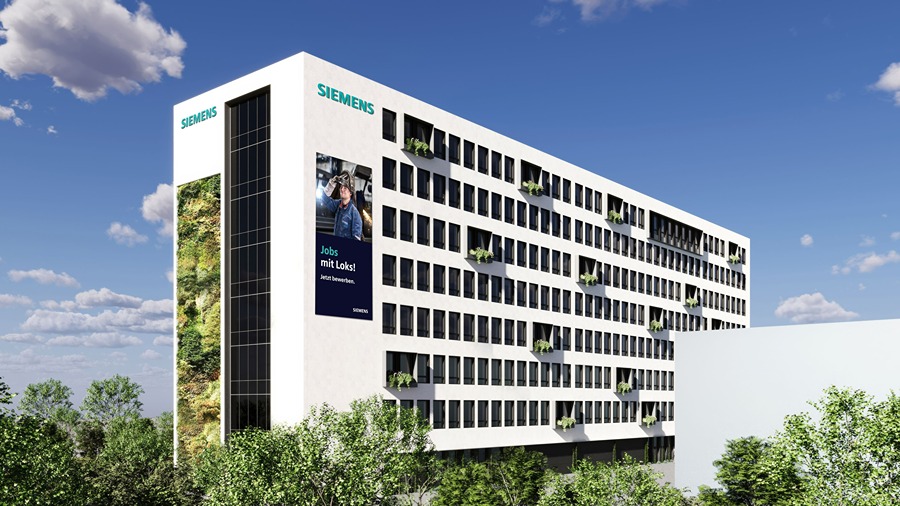
MUNICH, Germany, July 15, 2025 – Siemens has opened its expanded train factory in Munich-Allach, a central hub in its European service network. Around €250 million has been invested in infrastructure, production facilities, and AI-based software solutions. The expansion will support the production of up to 385 locomotives and 180 passenger cars annually and create over 500 new jobs. It emphasizes the company’s focus on Germany as a base for rail manufacturing and operations.
The expansion will bring the total workforce at the site to about 2,500 employees. The factory will also support production of Vectouro passenger cars alongside established Vectron locomotive models. This will be the first time Siemens produces all Vectron-based products in one location. The site will also triple its service capacity. Munich-Allach will become the new headquarters of Siemens Mobility, housing R&D, production, service, and management. By consolidating these functions, Siemens aims to improve integration and implementation efficiency as part of its ONE Tech Company program.
“In Allach, Siemens is demonstrating how competitive manufacturing is possible in Germany today: with superior products, maximum automation, digitalization, and the use of artificial intelligence. With the software and digital services offered to customers through our open business platform Siemens Xcelerator, we are showing the way to networked mobility of the future,” said Roland Busch, CEO of Siemens AG.
“The expansion of our location in Munich-Allach into a global competence center and home of the new company headquarters combines efficiency and innovation. With an investment of around €250 million in modern production facilities, service capacities, and digital solutions, we are securing our competitiveness and further boosting our innovative strength. By combining AI-based applications and innovative production technologies such as laser-guided installation, robotics, and digital twins, we are transforming ‘heavy metal’ into ‘heavy AI’ and taking the rail industry in Germany to a new level,” commented Michael Peter, CEO of Siemens Mobility.
“Munich-Allach is a beacon of our innovation strategy and a prime example of German engineering. With over 1.2 billion kilometers in service, our Vectron locomotives clearly prove that premium products can be successfully manufactured in Germany. We are proud to be creating more than 500 additional jobs in the ‘Home of Vectron’ and to be consolidating central functions such as management, development, production, and service in one location. This move will secure our role as industry leader and strengthen the economic power of Munich and Germany,” said Karl Blaim, CFO of Siemens Mobility.
Production expansion & investments
Siemens has expanded the Munich-Allach facility from 47,000 to more than 100,000 square meters, allowing for an increase in the production capacity. Technologies in use will include laser-guided installation, robotics, AI-enabled quality management, digital twins, and AI-based software development. The expansion establishes Munich-Allach as a center for developing, producing, and servicing sustainable rail vehicles. It will also enable Siemens Mobility to respond proficiently to changes in market demand.
Expanded Rail Service Center – capacity to triple by 2026
The Rail Service Center is expanded to increase its capacity from 25 to 80 locomotive overhauls and accident repairs per year. When finished, the center will triple its ability to handle heavy maintenance tasks to meet service demand and support faster turnaround times. The new facility will include four additional service tracks and workshops for bogies and wheelsets. Completion is scheduled for 2026.
Munich-Allach’s service offering will also include about 70 data and software specialists who will help international customers with digital transformation tasks using modular services and the Railigent X application suite. Combining production and service capabilities will establish Munich-Allach as a competence center and “Home of Vectron”.
Munich-Allach is growing: More than 2,500 employees by 2028
Siemens Mobility is relocating its headquarters from Munich-Perlach to Munich-Allach. The expansion will add more than 500 new jobs, in fields such as welding, metalworking, mechatronics, and electrical engineering. By 2028, the site is expected to employ over 2,500 people. This move will reinforce Munich-Allach’s role as a regional center and provide economic stimulus to the city, district, and local industry of Munich. The initiative reflects Siemens Mobility’s focus on job creation in Germany.
Source: Siemens
About Siemens AG

Siemens AG, headquartered in Munich, Germany, is a global technology company serving the industrial, infrastructure, transportation, and healthcare sectors. Founded in 1847, Siemens provides products and services such as industrial automation systems, digitalization solutions, energy-efficient technologies, and medical diagnostic equipment. In fiscal year 2024, ending September 30, the company reported revenue of €75.9 billion and net income of €9.0 billion. Siemens employs approximately 312,000 people worldwide, with about 90,000 located in Germany. The company holds a leading position in automation, industrial software, and digital solutions, and owns a majority stake in Siemens Healthineers, a publicly listed medical technology company focused on diagnostics and healthcare systems. Siemens applies industrial and generative AI technologies to improve efficiency, operational performance, and sustainability across manufacturing, infrastructure, and mobility. Its solutions combine physical systems and digital tools to support industrial processes, smart infrastructure, and connected mobility applications.
About Siemens Mobility

Siemens Mobility is the rail and transportation division of Siemens AG, headquartered in Munich, Germany, with roots dating back to 1989 and formal setup in 2018. The company provides rolling stock, rail electrification, signaling and automation solutions, and digital services for passenger and freight transport. Its products support urban transit, regional rail, intercity, and high-speed rail networks. Siemens Mobility also delivers full-turnkey rail infrastructure solutions and long-term maintenance services. In fiscal year 2023, the division reported revenue of approximately €10.5B and employed around 40,000 people globally. Its portfolio includes electric multiple units, locomotives, trams, automation platforms, and rail asset management tools. The company supports public and private clients in improving transit and logistics reliability, safety, and efficiency through integrated, data-driven systems.
