

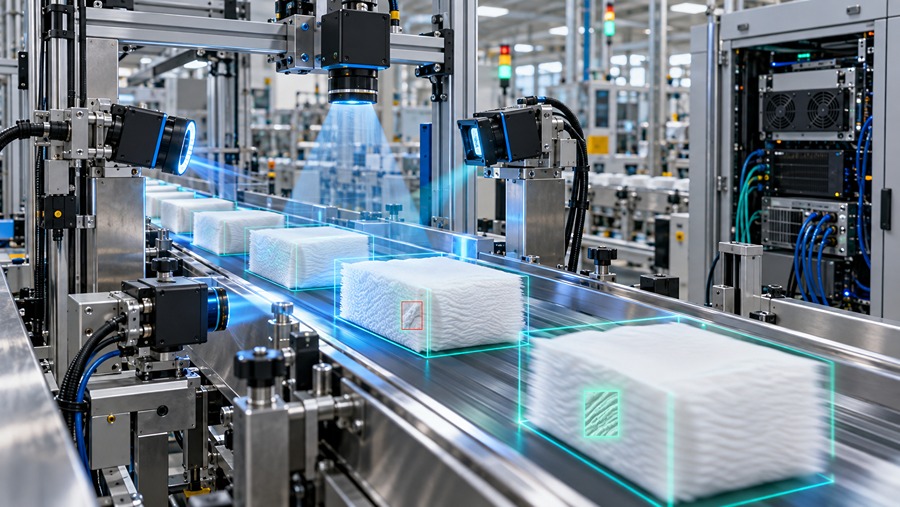
MUNICH, Germany, Sep 18, 2026 – Siemens and Procter & Gamble are expanding an AI-based inspection system across P&G’s manufacturing operations worldwide. The technology provides real-time inspection coverage at full line speed, helping maintain product quality.
The Visual Inspection Cockpit (VIC) checks consumer goods made from textured materials. These materials can shift, stretch or wrinkle during high-speed production. Conventional vision systems require reconfiguration when materials, packaging designs or production environments change.
VIC uses Industrial AI to accommodate these variations across different products. The system has reduced scrap rates by 10% to 20%, depending on the product. New deployments can also be commissioned five to 10 times faster than bespoke vision systems.
Siemens and P&G jointly developed the system. It combines P&G’s deep-learning models with Siemens’ Industrial Edge computing platform, industrial PCs, Nvidia GPUs, and AI hardware and software. Siemens provides the computing infrastructure, software scaling capabilities and operational support across production sites.
“Our Industrial AI and Industrial Edge capabilities deliver what high-speed production demands: full inspection accuracy for thousands of products per minute, scalable from a single line to a global footprint. This collaboration demonstrates what we mean when we say we’re making industrial AI real,” said Rainer Brehm, COO for automation and CTO at Siemens Digital Industries.
“We engineered this solution to solve a myriad of industry challenges traditional vision systems couldn’t touch: accurate characterization of overlapping components, the subtlety of low-contrast defects, the complexity of highly decorated products and packaging, tight time coordination, real-time PLC integration with single product reject at high production rates with continuous inspection,” said Paul Thomas, director of machine vision and applied AI at Procter & Gamble.
Siemens’ Industrial Edge processes inspection results near the production equipment and integrates them into manufacturing operations. The system can issue alerts or trigger the removal of defective products from the line. Production teams can also analyze quality data to identify trends and support improvement.
Source: Siemens
About Siemens AG

Siemens AG is a technology company founded in 1847 and headquartered in Munich and Berlin, Germany. The company develops products and services in industrial automation, electrification, digital systems, and mobility. Its offerings include automation systems, industrial software, building technologies, rail transport systems, and power distribution solutions. Siemens also provides financial services and supports infrastructure projects. It serves industries such as manufacturing, energy, transportation, construction, and healthcare. The company works with enterprises, utilities, governments, and infrastructure operators worldwide. Siemens operates in more than 190 countries. It applies digital tools and AI to industrial and infrastructure use cases. Siemens holds a majority stake in Siemens Healthineers, a publicly listed healthcare technology company. Siemens has about 318,000 employees globally.
About Procter & Gamble

Procter & Gamble, headquartered in Cincinnati, Ohio, was founded in 1837 by William Procter and James Gamble. The company makes and markets consumer goods in categories such as personal care, grooming, household cleaning, health care, baby care and fabric care. Its brands include Pampers, Tide, Gillette, Oral-B, Head & Shoulders and Pantene. P&G serves retail, e-commerce and institutional markets worldwide, with operations in more than 70 countries and products sold in over 180 markets. With more than 180 years in business, Procter & Gamble employs tens of thousands globally and remains one of the largest consumer goods companies in the world.
