

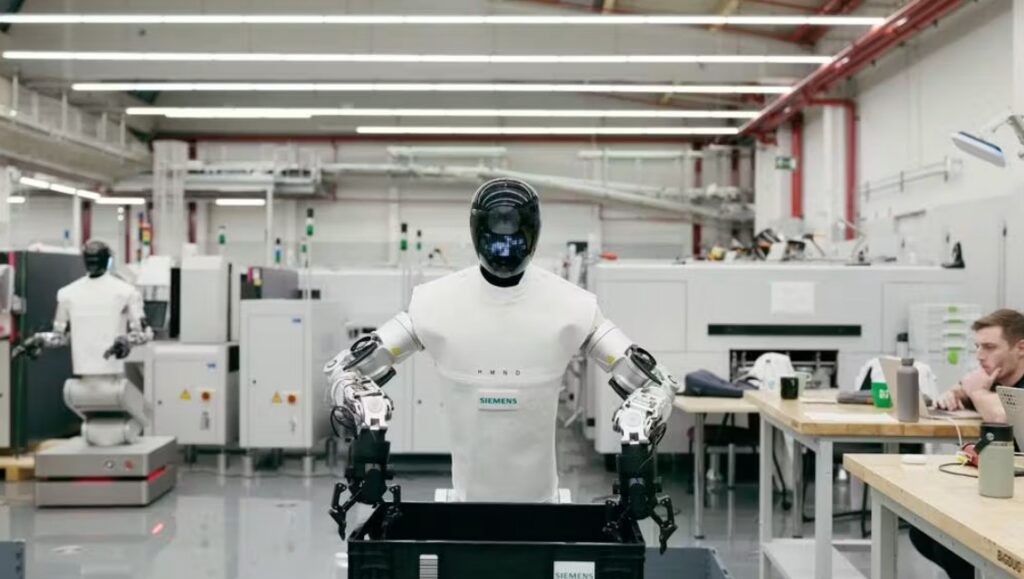
A recent article in Machine Design examines Siemens’ effort to move industrial AI and robotics beyond carefully controlled factory demonstrations into the messy realities of actual manufacturing environments. Central to this effort is the company’s work on “physical AI,” a concept that combines robotics, simulation, machine learning, and real-world sensing to create machines capable of adapting to changing industrial conditions rather than repeating fixed programmed routines.
The article focuses on Dr. Kal Mos of Siemens Corporate Research, who argues that the future of industrial automation depends less on perfect laboratory demos and more on building robotic systems that can function reliably amid unpredictability. Traditional industrial robots excel at repetitive tasks inside structured work cells, but modern factories increasingly demand flexibility, especially in logistics, assembly, warehousing, and small-batch manufacturing.
Siemens is collaborating with companies including Nvidia and Humanoid to refine AI-enabled robotic systems using simulation environments and digital twins. These virtual models allow robots to train in a large number of synthetic industrial scenarios before deployment on real factory floors. According to the article, simulation reduces development time while helping robots learn how to respond to unexpected obstacles, shifting layouts, and variable workflows.
The article also highlights Siemens’ interest in humanoid and flexible robotic systems that can work alongside people rather than inside isolated automation cages. Mos stresses that successful industrial AI requires contextual awareness, adaptability, and integration with existing manufacturing infrastructure. Instead of replacing human workers entirely, the technology is intended to augment labor in environments where staffing shortages and production variability continue to grow.
A recurring theme throughout the article is practicality. Siemens executives argue that industrial AI differs fundamentally from consumer AI because factories demand reliability, safety, and traceable decision-making. Industrial robots must operate consistently in high-consequence environments where downtime or unpredictable behavior carries serious operational costs.
The article presents Siemens’ robotics strategy as part of a broader transformation in manufacturing automation. Rather than pursuing fully autonomous humanoid visions disconnected from industrial realities, the company is focusing on systems that can gradually adapt existing factories into more flexible, AI-assisted production environments capable of responding to real-world complexity.
