
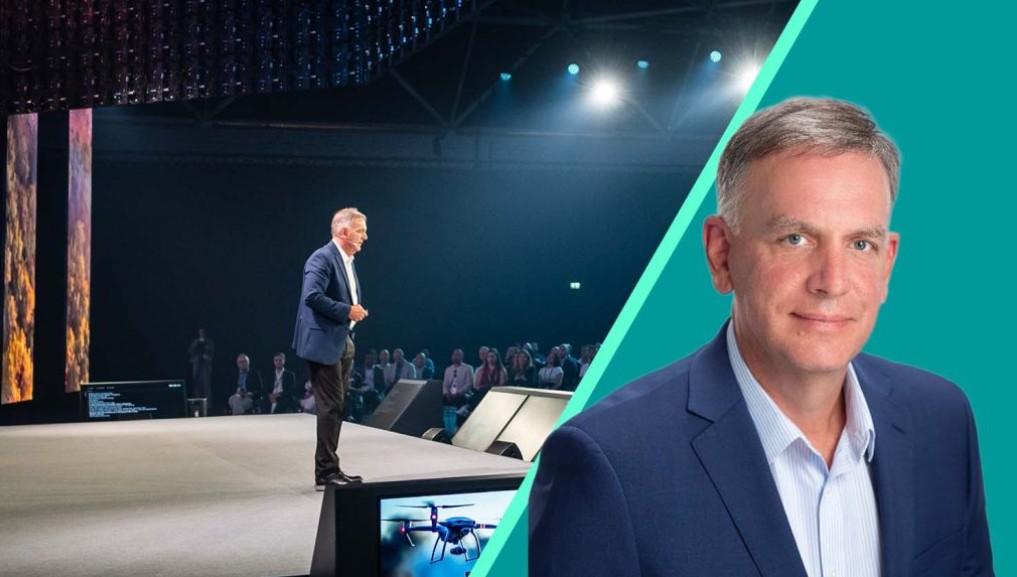
Siemens Digital Industries CEO Tony Hemmelgarn sees artificial intelligence changing how engineers interact with CAD software rather than replacing established engineering tools. In an interview with Develop 3D at Realize Live Europe, Hemmelgarn discussed Siemens’ evolving software platform, its Altair acquisition, AI integration, and the future of engineering software.
Hemmelgarn said the Altair integration is progressing well, with SimSolid and PhysicsAI providing important additions to Siemens’ portfolio. He also sees opportunities for Altair customers to adopt Teamcenter and for existing Siemens PLM users to expand into simulation. Siemens intends to maintain an open approach, supporting third-party software while offering tighter integration among its own products.
For AI, Hemmelgarn argues that the industry does not need another CAD modeler. Greater value can come from connecting capable large language models to existing engineering systems through APIs. Siemens demonstrated this concept by linking Claude to an NX rocket model. Using geometry and design relationships, the AI analyzed characteristics such as payload capacity and then modified the model when instructed to increase that capacity. However, Hemmelgarn acknowledged that AI-generated results still require verification.
He expects AI to change access to engineering software while leaving underlying physics and deterministic engineering capabilities intact. Siemens could increasingly charge for AI-driven software usage through its existing value-based token licensing model. This approach could also help customers control AI-related computing costs.
Looking ahead, Hemmelgarn expects closer integration among CAD, EDA, PLM, supply chain information, simulation, and manufacturing operations. Designers could increasingly receive real-time manufacturing costs while developing components. Executable digital twins may also connect simulation more directly with factory operations.
Hemmelgarn also expects visualization to become progressively more photorealistic as GPU performance improves and costs decline. Overall, his view of engineering software centers on connected tools, practical AI applications, and automation that helps engineers complete more work faster rather than eliminating their role.
