

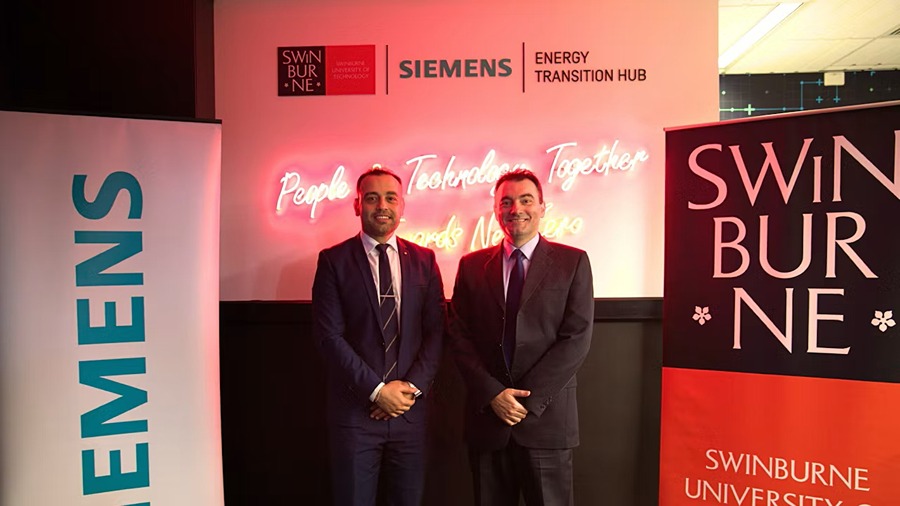
Australia, Nov 19, 2026 – Siemens and Swinburne University of Technology are expanding their Australian energy and power systems collaboration across Asia through the Siemens Swinburne International Energy Transition Alliance for Industry Training and Innovation. The alliance plans to establish its first international training and innovation node in Malaysia by the end of 2026.
The alliance will provide industry professionals with access to training, technical expertise in power systems, renewable energy integration and the energy transition.
The international nodes will operate as extensions of the existing AU$5.2M Siemens Swinburne Energy Transition Hub in Melbourne. Programs will be coordinated through the Australian facility and delivered in collaboration with local institutions. The arrangement will address workforce skill-gaps and connect universities with the energy industry.
Launched in 2023, the Melbourne Hub combines Siemens digital energy technology with Swinburne’s research, teaching and technical expertise. It supports training, research and commercialization activities and is accessible to students, academic institutions and industry professionals.
Peter Halliday, managing director of Siemens Australia and New Zealand, said: “The energy transition is a global challenge, and developing the right skills and capabilities is just as important as deploying the right technology. Australia has enormous expertise in tackling this transition. Through our collaboration with Swinburne, we’ve combined world-leading technology, research and practical industry experience. This next chapter is about taking that capability beyond Australia, starting in Malaysia, and working with local universities and industry to address each country’s own energy challenges.”
Jose Moreira, head of the grid software business for Siemens in Asia Pacific added: “Our collaboration with Swinburne continues to evolve, extending into other areas such as research on the role of AI in achieving Net Zero and the first Australian study on quantum timing to strengthen the future of power grids. It is a strong example of how we can connect academic expertise with real industry challenges and develop solutions with practical impact. We now have an opportunity to take this model beyond Australia and expand it internationally.”
Associate professor Mehdi Seyedmahmoudian, director of the Siemens Swinburne Energy Transition Hub commented: “Through this Alliance, we are creating a connected network of international partners to equip energy professionals across Asia-Pacific with the skills and technologies needed for the energy transition. The energy transition is about more than producing renewable electricity. It is also about giving people the skills and tools to keep an increasingly complex energy system secure, reliable and resilient.”
Source: Siemens
About Siemens AG

Siemens AG is a technology company founded in 1847 and headquartered in Munich and Berlin, Germany. The company develops products and services in industrial automation, electrification, digital systems, and mobility. Its offerings include automation systems, industrial software, building technologies, rail transport systems, and power distribution solutions. Siemens also provides financial services and supports infrastructure projects. It serves industries such as manufacturing, energy, transportation, construction, and healthcare. The company works with enterprises, utilities, governments, and infrastructure operators worldwide. Siemens operates in more than 190 countries. It applies digital tools and AI to industrial and infrastructure use cases. Siemens holds a majority stake in Siemens Healthineers, a publicly listed healthcare technology company. Siemens has about 318,000 employees globally.
