

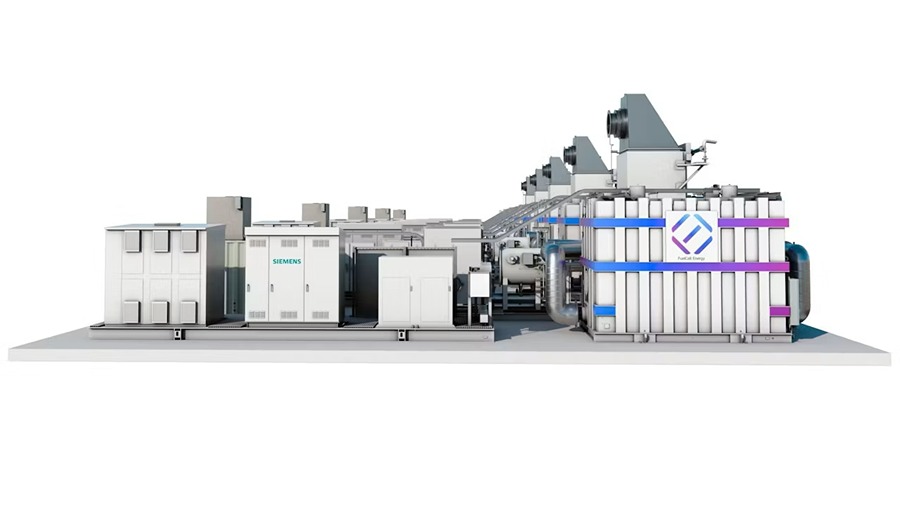
WENDELL, NC and DANBURY, CT, July 9, 2026 – Siemens will design and supply electrical balance of plant systems (EBOP) for FuelCell Energy fuel cell installations, supporting 100+ MW commercial energy projects for data centers, industrial facilities, utilities and other distributed generation customers.
The companies said that the collaboration aligns Siemens’ electrical design and supply work with FuelCell Energy’s fuel cell power generation technology. FuelCell Energy designs, manufactures, operates and services fuel cell power plants for mission-critical applications globally. The work spans engineering, integration and delivery of distributed energy systems that incorporate fuel cells, battery energy storage, microgrid controls and medium-voltage electrical equipment.
“The rapid growth of electrification and distributed energy is redefining how power must be delivered at scale,” said Kevin Brown, Head of Sustainability Solutions, electrification and automation, Siemens Smart Infrastructure USA. “By combining FuelCell Energy’s fuel cell technology with Siemens’ electrical infrastructure, service, and integration expertise, we can deliver scalable, on-site power solutions for energy-intensive applications – helping customers deploy power faster, scale with confidence, and advance their transition to lower-emission, more resilient energy systems.”
FuelCell Energy’s chief product and technology officer, Shankar Achanta, said, “This collaboration with Siemens enables us to deliver what the market has been asking for – bringing generation and electrical infrastructure together into a single, scalable solution. For customers, that means reliable, on-site power that is faster to deploy and built to scale, beginning with the data centers driving today’s demand.”
The agreement also covers pilot projects and development work for fuel cell systems and electrical infrastructure. The companies will assess medium-voltage DC power delivery and modular electrical systems. Siemens and FuelCell Energy said successful pilot results could move into full-scale commercial deployments, including the identification of target markets and deployments.
Source: Siemens
About Siemens

Siemens Corporation, the U.S. subsidiary of Siemens AG, operates across industry, infrastructure, transportation, and healthcare sectors. Founded in 1847, Siemens AG has more than 175 years of history and is headquartered in Munich, Germany. Its U.S. operations are based in Washington, D.C. The company maintains 24 manufacturing sites in the United States and employs over 50,000 people, serving customers in all 50 states and Puerto Rico. Siemens focuses on integrating digital and physical technologies to support customer needs in efficiency, urban development, and sustainable transportation. The company applies industrial AI – including generative AI – to use cases across sectors.
About Siemens Smart Infrastructure

Siemens Smart Infrastructure, a division of Siemens AG, is headquartered in Zug, Switzerland. The division integrates energy systems, buildings and industrial processes to improve efficiency and support modern infrastructure needs. It provides HVAC controls, fire safety systems, security technologies, energy-performance services, grid-resilience tools and electric-vehicle charging equipment. Its offerings serve sectors such as data centers, energy and manufacturing. The division develops systems that span the energy value chain, from power generation to end use, and focuses on addressing challenges related to urbanization and climate change. It also places emphasis on cybersecurity to support secure and reliable operation in increasingly digital environments. Siemens Smart Infrastructure employed about 80,000 people.
About FuelCell Energy
FuelCell Energy is a U.S. energy technology company founded in 1969 and based in Danbury, CT. The company designs, makes, installs, operates and maintains megawatt-scale stationary fuel cell systems. Its carbonate fuel cell systems provide on-site power, grid support, microgrid service, thermal energy, biogas use and carbon capture. The company also develops solid oxide electrolysis technology for hydrogen production. Its systems generate electricity through electrochemical reactions. FuelCell Energy serves utilities, independent power producers, data centers, wastewater treatment plants, manufacturers, hospitals, universities, municipal users and industrial customers. It sells mainly in North America, Europe, the United Kingdom and Asia. Asian markets include South Korea, Singapore, Malaysia and Thailand.
