

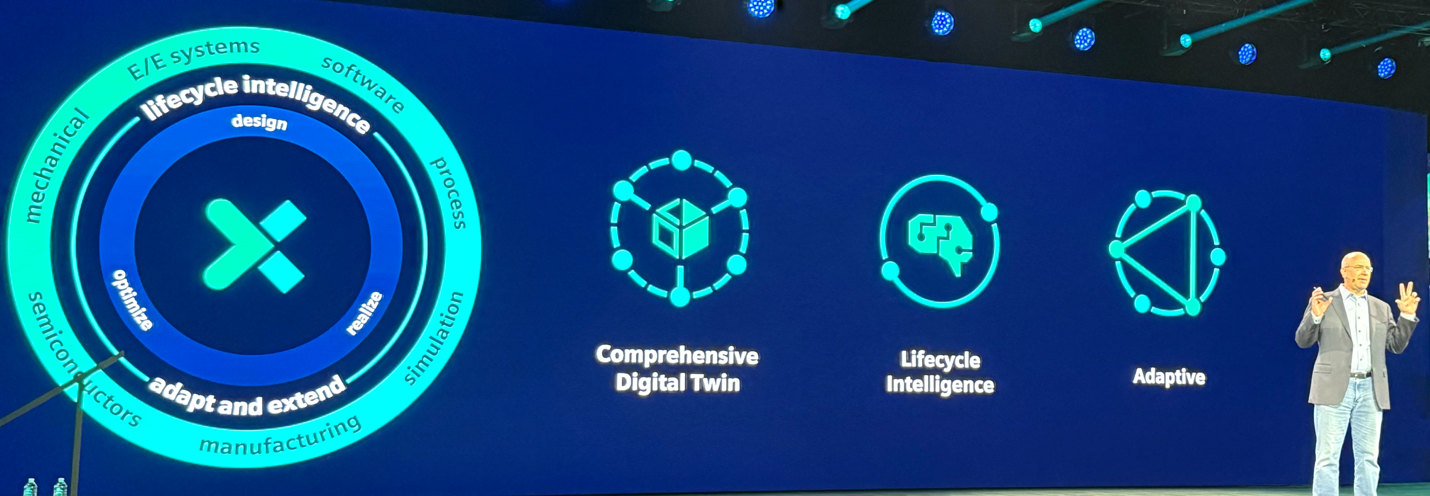
 Joe Bohman, Executive Vice President of PLM Products at Siemens, opened his Day 2 keynote at Realize Live 2026 in Detroit with a sports metaphor. The 1992 U.S. Olympic basketball Dream Team — Michael Jordan, Larry Bird, Magic Johnson — didn’t win just because they had the best players. They won because they played together.
Bohman’s dream team is part by acquisition and homegrown. Siemens claims to have spent a total of €25 billion to make a portfolio second to none in the design, engineering and manufacturing space. Recent huge acquisitions: Altair ($10 billion), Mentor ($4.5 billion) and Mendix (€600 million). Homegrown were: Opcenter, Simcenter, PAVE360…
Siemens does not intend to let those players be one-man shows; it intends that they play as a team.
An Integration Nightmare
Bohman says 52% of engineering managers identify software-hardware integration as their single biggest challenge. Bohman calls it the integration nightmare.
A modern software-defined product, such as today’s automobile, may have been designed to operate with 30 different development tools. Siemens talks to customers who are running millions of functional tests of their products. Safety tests alone can involve dozens of standards; cybersecurity hundreds, with new ones appearing constantly.
The deeper problem: software teams may have to write code before the electronics are assembled, maybe before the microprocessors are ready, before the boards are ready, the wire harnesses…To cope, the industry has developed various test loops. There are model-in-the-loop (MIL) tests, software-in-the-loop (SIL) and hardware-in-the-loop (HIL). It is the most time-consuming approach, says Bohman.
Instead, Bohman offers Siemens’ continuous verification — running the software stack against simulated silicon and simulated boards before any physical silicon or hardware is created.
The demo walked through adding an avoid-and-detect neural for a drone. Using Clarion to orchestrate the software process, Capital and PAVE360 to simulate boards and silicon, and Simcenter to handle the simulation, the team surfaced a timing failure — 500 milliseconds where 100 was required — identified that the GPU was undersized, added a neural processing unit in the architecture, and reran. Tests that were failing passed.
All of it before a single chip had been manufactured.
Siemens’ customer in this case was Apptronik. Their humanoid robot Apollo is being developed with Google DeepMind handling the software and Apptronik handling the hardware.
Simcenter Gets a Rebuild
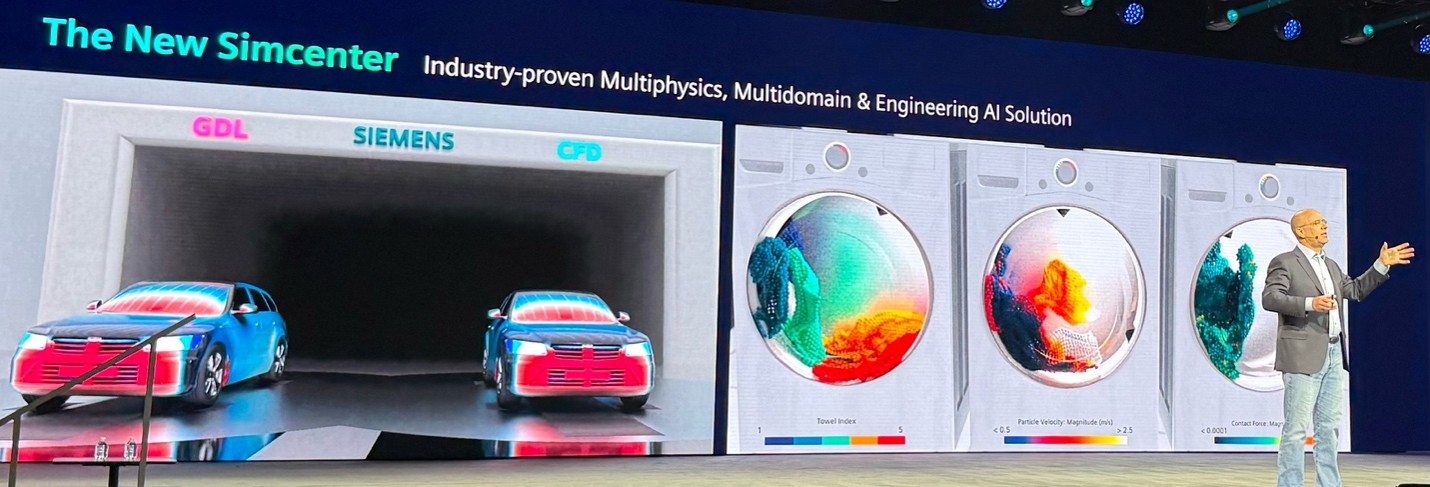
Simcenter — what Bohman called a “market-defining convergence” of simulation, high-performance computing, and AI, built from the merger of Siemens’ existing simulation portfolio with Altair.
The backstory matters. McKinsey data cited by Bohman puts the average time to production at 40 to 50 months for manufacturing companies, with 60% of that time consumed by physical prototyping. Simcenter is Siemens’ argument that most of that prototyping is unnecessary.
AI enters the new Simcenter in three ways. First, faster engines: geometric deep learning is being baked into simulation solvers, training neural networks on simulation outputs to dramatically reduce compute time. Bohman showed a Continental airbag example — a nonlinear simulation that took several hours with traditional methods, but only seconds with Physics AI. The stated speedup: 240 times!
Multi-physics. The new Simcenter collapses multiple solvers into one. LG Vehicle Solutions came in needing four different solvers to model a vehicle’s full physics behavior; Siemens collapsed all four into OptiStruct, and LG went 20% faster. Leonardo used the same approach to combine vibration and electromagnetic simulation for a helicopter radar system.
GPU. Everything in the new Simcenter is GPU-enabled. With BMW, using the Star-CCM+ fluids and thermal solver on GPU hardware, the result was three times faster computation at six times less energy, on figures that had already been heavily optimized on CPU.
SimSolid: the only meshless simulation tool is now available with value-based licensing directly in Simcenter.
“Designcenter and Simcenter together are the future of engineering.” Said Bohman.
Intelligencecenter X
Intelligencecenter X is Siemens’ new one-stop platform for agentic enterprise development. It is, by now , a familiar pattern: Designcenter X, Simcenter X, Teamcenter X, Opcenter X — Intelligencecenter X.
The platform bundles four components: Mendix for agentic development and orchestration; Graph Studio, backed by a massive graph database for putting data in context; AI Studio for machine learning and statistical process control; and industrial ontology, a layer that brings disparate data sources — PLM, ERP, CRM, in-house systems — into a unified, queryable structure.
Bohman’s scenario: part data lives in PLM, vendor data in ERP, customer data in CRM and warranty data in an in-house system. Intelligencecenter X’s industrial ontology pulls it together. The demo showed a copilot agent handling a landing gear hydraulic change on a commercial aircraft — finding impacted items in seconds, recommending alternative parts ranked by supply chain risk and warranty history across all four data sources, then identifying Simcenter simulations to validate the replacement.
GlaxoSmithKline (GSK) is running an Intelligencecenter X graph with 15 billion nodes, says Bohman. They’ve gone from hours to seconds on supply chain risk analysis.
Gartner, no surprise to Bohman, named Siemens the company to watch in manufacturing AI.
Vibe Coding
The factory of the future is where Siemens may have the most credibility and impact. Take, for example, Foxconn, the Chinese manufacturing giant that makes Apple’s iPhones. They came to Siemens with a specific problem: they had built AI factories and needed help designing and operating a component test room. The design phase used Digital Twin Composer and Process Simulate to evaluate 1,000 different layout configurations before selecting the optimal one. Standard stuff for the Siemens portfolio.
We see a live demo where, using Opcenter, Foxconn realized the system was missing inputs for power consumption and heat. A Siemens engineer typed a prompt, and voilà, those systems were added to Opcenter. On stage. In real time. Mendix understands how to generate application code from natural language, plain English, in this case.
Opcenter is built around Mendix. A prompt flows through Intelligencecenter X into Mendix, which modifies Opcenter’s underlying application logic and surfaces the result. No developer in the loop.
“Vibe coding without the hangover,” says Bohman, in what may be the catchiest phrase generated during the conference.
He can hardly believe it himself.
“My team showed me this,” he says. “It could not be that easy. But it is… that easy.”
The phrase “vibe coding” has been circulating in the development sphere of late.
Vibe coding, to the best of my understanding, is what happens when you use LLMs (large language models) to generate code without knowing or caring about learning a computer language. Like C++ or Python. It’s super fast. It can make an ordinary engineer feel as if they are a super coder. What “hangover” has to do with it is not clear. It might be about how you don’t have to deal with the potential fallout from your amateurish attempts to drive too fast without a license.
In this case, it’s Mendix (the Siemens acquisition) that puts guardrails in place to protect you. The model knows the Opcenter schema, the platform enforces the constraints, and the output is production-grade application logic, not a script that breaks in a week.
The implication for enterprise software customers is significant. The ability to modify operational manufacturing software through natural language — without a professional developer, without a long upgrade cycle — is not a demo concept. Siemens ran it live on a real customer’s real system.
Cloud: The X Products
Bohman referred to how Microsoft Office became Microsoft 365, how Adobe Creative Suite became Adobe Creative Cloud. In that way, Siemens Xcelerator could be the transition for users of engineering software.
The numbers he cited were striking in different ways. Teamcenter X is growing at 100% year over year. Designcenter X is pulling in customers migrating from Dassault, PTC, and Autodesk. Mercedes-Benz is fully committed to Designcenter X; Cronus AG has taken 1,000 seats.
It’s “shocking that 50% of CAD users are still on the file systems,” says Bohman, instead of databases. The X products, Bohman argued, are their salvation. With them, users are one click away from AI-enabled digital threads.
One thing being database-based is the updating of your software. With the X products, updates occur daily. But by the end of the year, it will be twice a day.
At the end of the keynote, here’s what I’ve got: Siemens is, perhaps uniquely, able to handle the design of software-defined products, the new Simcenter, Intelligencecenter X, the factory of the future, cloud, interesting individually but all together, describe something larger: a single company with enough of the stack to actually connect all the pieces.
