

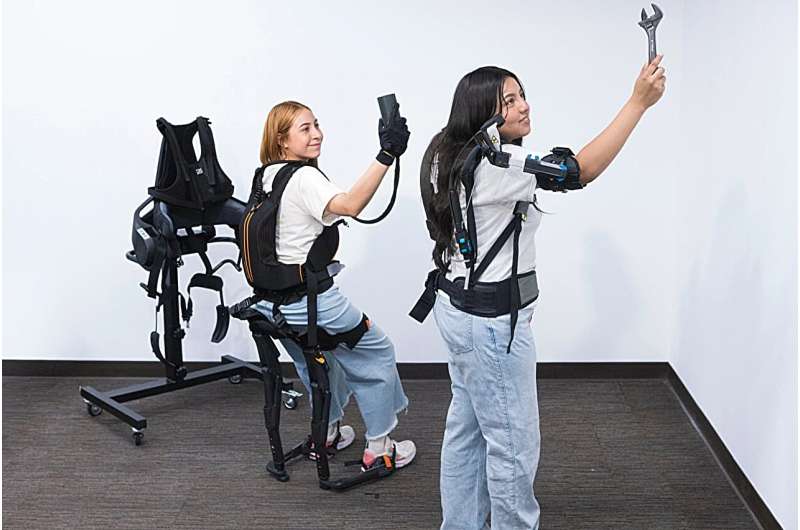
Wearable exoskeletons have long been promoted as a way to reduce physical strain, prevent injuries, and improve worker well-being in industries such as manufacturing, construction, and health care. However, new research from the University of Texas at El Paso suggests that the success of these devices may depend less on their biomechanical performance and more on a surprisingly simple factor: ease of use, tells Tech Xplore.
Published in PLOS One, the study examined four commercially available occupational exoskeletons: Ironhand, Chairless Chair, Skelex, and Laevo. Researchers evaluated the time required to assemble, put on, remove, and disassemble each device while also tracking the number of setup steps, components, and usability issues encountered by users. The goal was to understand whether practical usability barriers might be limiting workplace adoption.
The results revealed significant differences among the systems. The simplest exoskeleton required 39 procedural steps to set up, while the most complex demanded 110 steps. Assembly times ranged from approximately six and a half minutes to 25 minutes. Researchers found that every additional setup step increased completion time, and usability problems further slowed users. One device experienced failure rates approaching 49% during the setup process.
According to the research team, a device that effectively reduces physical strain offers little value if workers struggle to assemble it, require assistance to wear it, or spend excessive time preparing it for use. These practical challenges can discourage workers from incorporating exoskeletons into their daily routines, regardless of the ergonomic benefits provided.
The study was conducted in a controlled laboratory environment using engineering students as participants. Researchers believe the next step is to evaluate exoskeletons in real workplace settings where time pressures, repetitive use, and operational demands more closely reflect everyday conditions.
The findings highlight a critical shift in exoskeleton design priorities. As manufacturers seek broader adoption, reducing setup complexity, minimizing user errors, and improving overall usability may prove just as important as enhancing mechanical assistance. The future of workplace exoskeletons may depend not on adding more features, but on making the technology easier for workers to use correctly and consistently.
