

As electric vehicles, wind farms, data centers, and other high-voltage applications become more common, the reliability of the electronics that power them is increasingly important. One of the biggest threats to these systems is humidity. Moisture can condense on electronic surfaces, triggering corrosion that leads to leakage currents, electrochemical migration (ECM), dendrite formation, short circuits, and, in severe cases, fire. Researchers at the Centre for Electronic Corrosion (CELCORR) at the Technical University of Denmark (DTU) are tackling this challenge by developing simulation tools that predict corrosion before products are built, tells IEEE Spectrum.
According to CELCORR manager Dr. Rajan Ambat, many electronic failures caused by corrosion go undetected because the moisture responsible often disappears before engineers inspect the failed device. Unless dendrites are visible, corrosion is rarely identified as the root cause. This makes proactive design essential, particularly for electronics operating in humid or coastal environments.
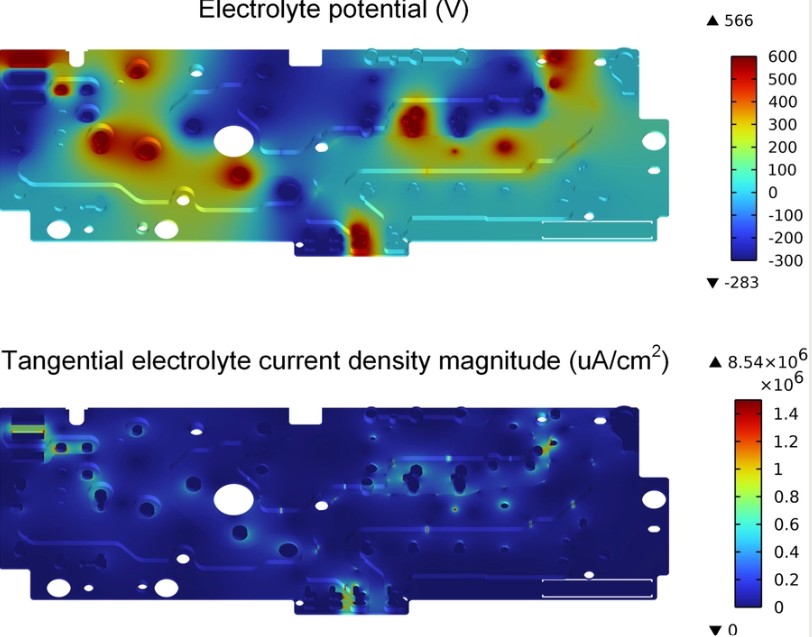
To better understand these failure mechanisms, the research team uses COMSOL Multiphysics software to model printed circuit boards (PCBs) under varying humidity conditions. Their simulations include a thin water film that represents condensation and allow researchers to modify factors such as PCB layout, electrode spacing, water-film thickness, and conductivity. By calculating electrochemical leakage currents under different conditions, the team can determine which design changes improve resistance to corrosion.
CELCORR has also developed user-friendly simulation applications for its industry partners. These apps simplify the modeling process by allowing engineers to adjust design variables through an intuitive interface without requiring expertise in simulation software. Companies can quickly evaluate different design options and identify configurations that are more resistant to moisture-related failures while avoiding costly physical testing.
The research is now expanding beyond basic PCB models to more sophisticated simulations that examine chemical reactions, mass transport, and high-voltage systems in greater detail. Supported by the Centre for Climate Robust Electronics Design (CRED), established through a 2024 Grundfos Foundation grant, the team aims to create environmentally resilient electronics capable of operating reliably in challenging climates. Their work demonstrates how multiphysics simulation is becoming an essential tool for designing safer, longer-lasting electronic systems.
