

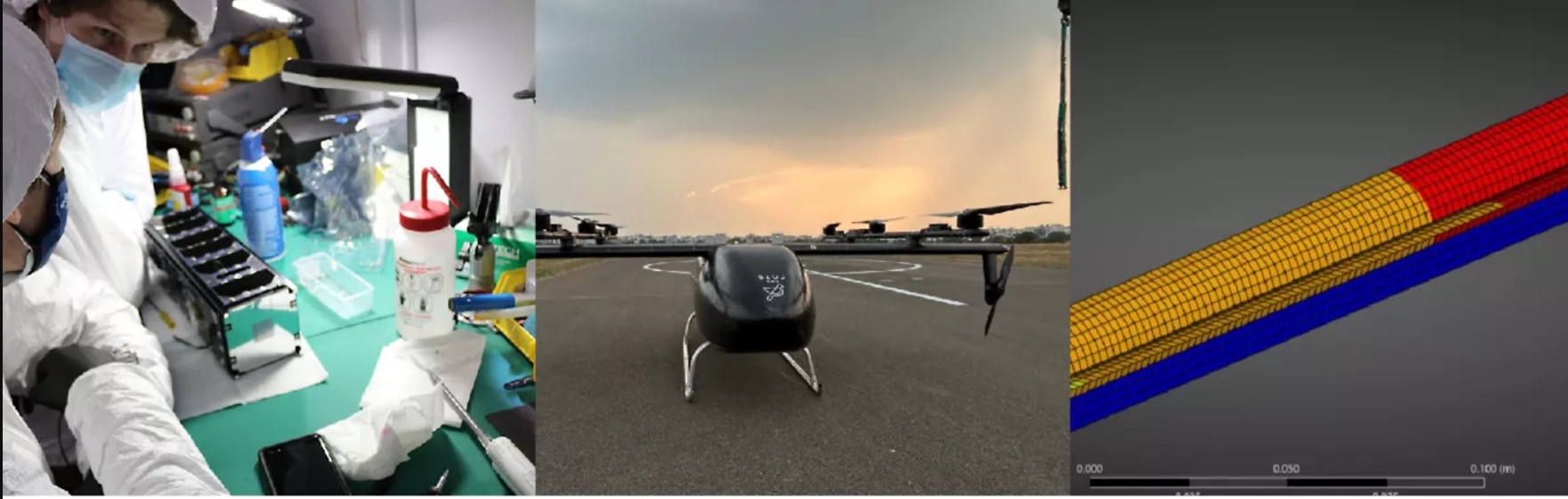
Simulation is helping emerging aerospace teams tackle complex engineering challenges without the budgets and resources available to established manufacturers. Ansys highlights three projects that use virtual engineering to improve designs, reduce physical testing, and prepare new aerospace technologies for real-world deployment.
Imperial College London’s Project Svarog is developing solar sail technology with the long-term goal of creating a student-built spacecraft capable of leaving the solar system. The team uses Ansys Mechanical, Composite PrepPost, and Discovery to design lightweight, deployable carbon-fiber composite booms. Engineers optimized composite layers and orientations for launch and deployment loads. The resulting booms weigh substantially less than an earlier spring-steel design while providing comparable strength. Simulation also helped the team predict whether its CubeSat structure would survive prelaunch testing.
Indian startup BluJ Aero applies multiphysics simulation to electric and hydrogen-electric vertical takeoff and landing aircraft. One major challenge involves Type IV hydrogen storage tanks, where engineers must balance high-pressure containment, structural safety, and low weight. BluJ used composite and structural simulations to predict pressure capacity and failure locations. A physical hydrostatic burst test closely matched the simulation results, giving the team greater confidence to optimize the tanks while limiting repeated prototypes. Ansys Fluent also supports aerodynamic studies.
The University of Toronto Aerospace Team is taking simulation into nanosatellite development. Its FINCH project aims to use hyperspectral imaging for mapping agricultural crop residue. To achieve high spatial resolution within a compact CubeSat, students developed a monolithic catadioptric lens that folds the optical path. Ansys Zemax OpticStudio supported lens design and optimization.
Across the three projects, simulation serves more than design validation. It allows teams with limited resources to explore alternatives, identify problems before manufacturing, and build engineering skills. The projects demonstrate how virtual testing can help move ambitious aerospace concepts from early ideas toward manufacturable, flight-ready systems.
