

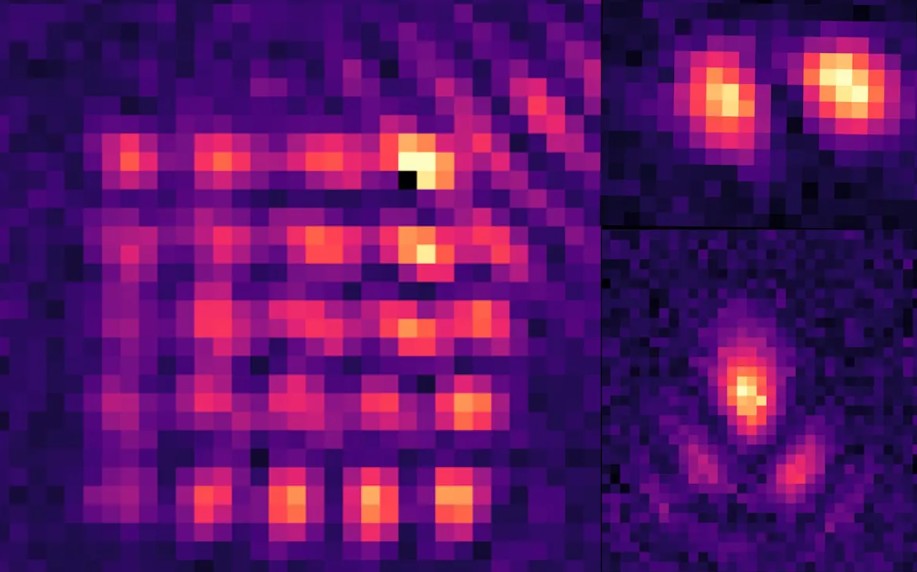
Researchers in Japan have developed an innovative imaging system that uses a single ultracold atom as a nanoscale camera, demonstrating a technique that could significantly improve the development and operation of neutral-atom quantum computers. Rather than capturing conventional photographs, the so-called atom camera maps the intensity and polarization of light with a spatial resolution beyond the diffraction limit of traditional optical microscopes, allowing engineers to visualize optical structures that were previously impossible to observe directly, tells IEEE Spectrum.
The system relies on a single rubidium-87 atom trapped inside an optical tweezer and cooled to nearly absolute zero. As laser light interacts with the atom, it alters the energy states of the atom’s electrons. By measuring these tiny changes, researchers can determine the properties of the incoming light. To construct a complete image, they move the light pattern across the stationary atom in 100-nanometer increments, recording measurements at each position before reconstructing a detailed two-dimensional map. This approach produces images of light patterns with exceptionally high spatial resolution.
While the technique represents an impressive advance in optical measurement, its greatest potential lies in quantum computing. Neutral-atom quantum computers use optical tweezers and complex laser systems to trap, position, and manipulate individual atoms that serve as qubits. Maintaining precise laser alignment and polarization is critical for reliable quantum operations, yet existing imaging methods struggle to inspect these delicate optical fields without disturbing the system. The atom camera offers a nonintrusive way to diagnose and optimize these laser configurations inside quantum hardware.
The research also builds on earlier efforts to use individual atoms as probes for super-resolution imaging, extending previous demonstrations by measuring not only light intensity but also polarization. This added capability provides a more complete picture of the optical environment surrounding quantum devices.
Although the technology is not intended for consumer imaging, it highlights the growing role of atomic-scale measurement techniques in next-generation computing. As neutral-atom quantum computers continue to scale in size and complexity, tools such as the atom camera could become essential for debugging, calibrating, and improving quantum processors, helping accelerate the transition from laboratory experiments to practical quantum systems.
