

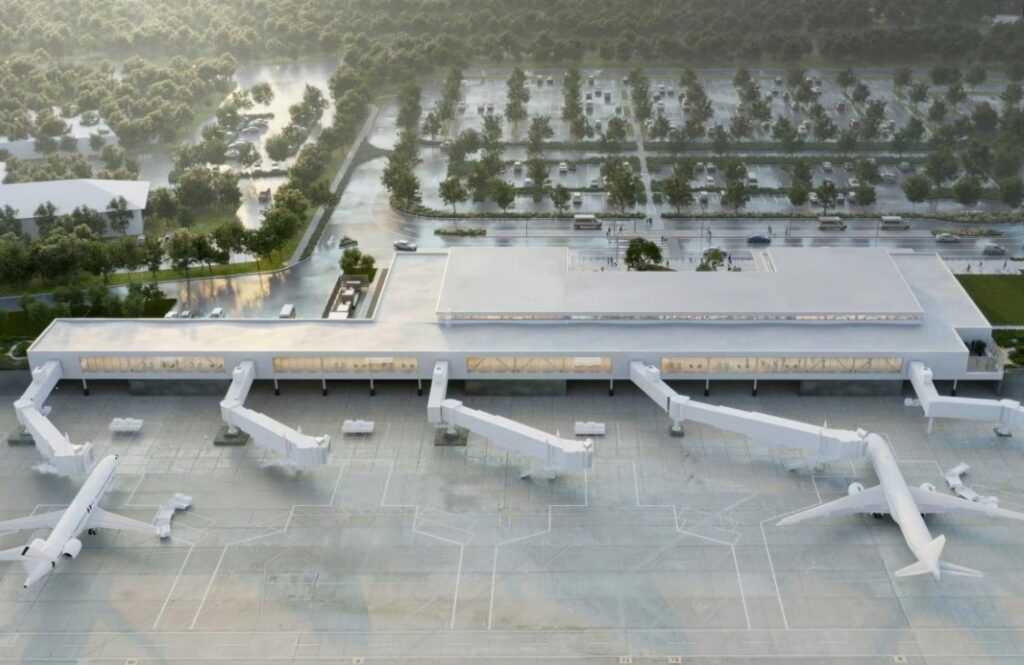
HOK’s article tells the design story behind the new terminal at Monterey Regional Airport (MRY), a project expected to become the first net-zero-ready airport terminal in the United States. Rather than attributing the achievement to a single technology, the article explains how a series of interconnected design decisions enabled the project to meet ambitious sustainability goals while creating a distinctly regional passenger experience.
From the beginning, the project team established a clear vision: create an all-electric terminal capable of achieving LEED Platinum certification, reducing operational energy use, lowering embodied carbon, and reflecting the character of California’s Central Coast. These objectives guided every stage of the design process.
The first major strategy was a place-based approach. Designers studied Monterey’s climate, ecology, and landscape to create a building that responds naturally to its environment. Extensive glazing, daylight-filled interiors, landscaped courtyards, and strong visual connections to the surrounding region help define the passenger experience while reducing dependence on artificial lighting.
The second strategy involved reducing energy demand before generating renewable energy. Through careful building orientation, exterior shading, high-performance glazing, daylight modeling, and an optimized building envelope, the team significantly lowered energy loads. Program efficiencies and operational planning further improved performance.
A third focus was embodied carbon reduction. Mass timber became a defining architectural and structural element, helping reduce the building’s carbon footprint while creating a warm, welcoming atmosphere. The project team initially targeted a 37% reduction in embodied carbon, though procurement challenges ultimately limited reductions to approximately 18%.
Integrated engineering formed another key component of the project. Mechanical, electrical, and structural systems were developed together, resulting in the use of heat-pump chillers, thermal energy storage, dedicated outdoor air systems, advanced controls, and a hybrid timber-and-steel structural system.
The final step was matching the building’s reduced energy demand with renewable generation. An existing 862-kilowatt solar array produces roughly 1,500 megawatt-hours annually, enough to offset projected terminal energy consumption. Combined, these strategies are expected to reduce energy use by about 34% compared with a LEED baseline while enabling net-zero operation.
HOK presents the project as a model for future airport infrastructure, demonstrating that net-zero performance emerges from integrated design thinking rather than isolated sustainability measures.
