

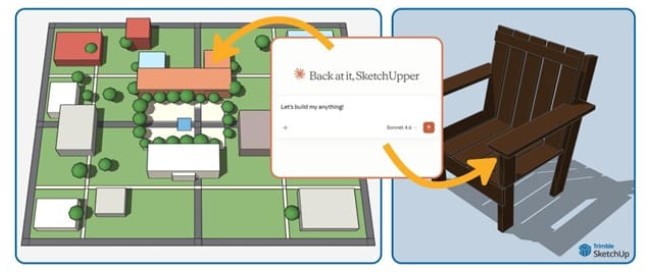
SketchUp has introduced a new artificial intelligence feature powered by Anthropic’s Claude model, marking a significant step toward conversational 3D modeling inside mainstream design software. According to Architosh, the integration allows users to interact with SketchUp via natural-language prompts, reducing reliance on traditional menus, toolbars, and manual command sequences.
The new AI capability is designed to help users generate geometry, automate repetitive modeling tasks, and receive contextual assistance directly within the application. Instead of navigating complex workflows, designers can describe actions conversationally, such as creating objects, modifying forms, or organizing scenes. The approach reflects a growing industry trend in which AI systems function less as isolated assistants and more as embedded collaborators inside creative and engineering environments.
The article positions the Claude integration as part of a broader transformation across CAD, BIM, and digital design platforms. Software developers are increasingly exploring large language models as interfaces capable of simplifying technical workflows for both experienced professionals and new users. By translating intent into modeling operations, AI systems could reduce friction in early-stage concept development and accelerate iterative design work.
SketchUp’s adoption of Claude also highlights the expanding role of generative AI beyond text generation and image synthesis. In 3D design, the technology is beginning to reshape interaction paradigms by connecting language directly to geometry creation and scene manipulation. The article notes that this evolution may eventually alter expectations for how designers communicate with software itself.
At the same time, the report suggests that AI-assisted modeling remains an evolving technology rather than a finished replacement for professional expertise. Designers still need judgment, spatial understanding, and technical accuracy. However, the integration demonstrates that conversational interfaces are becoming increasingly central to the future of digital modeling, especially as AI tools mature across architecture, engineering, construction, and industrial design workflows.
