

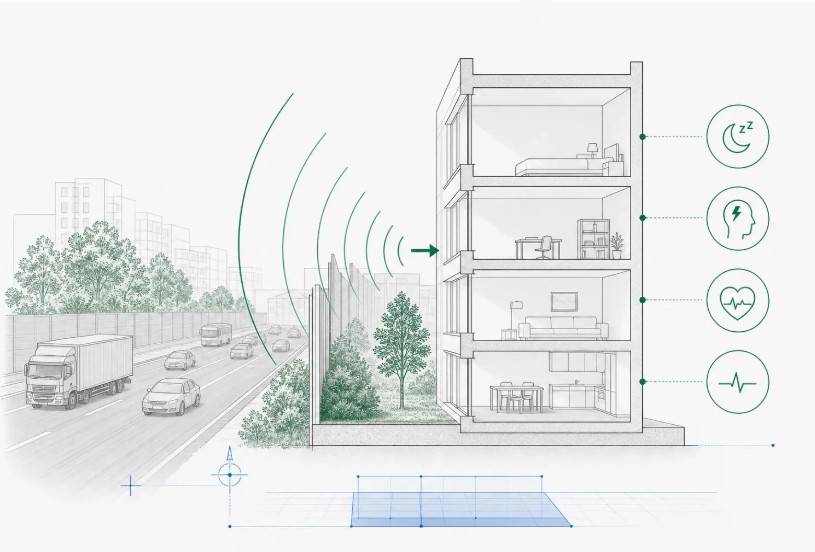
Traffic noise is a growing concern in urban architecture, affecting residents’ health, sleep, and quality of life. According to Spacio, architects can address this challenge more effectively through early design decisions rather than relying on expensive acoustic treatments after building layouts are finalized.
The European Environment Agency estimates that more than 20% of the European Union’s population experiences potentially harmful transport noise. The World Health Organization recommends keeping road traffic noise below 53 decibels across the day-evening-night average and 45 decibels at night. Prolonged exposure is associated with sleep disturbances, stress, and cardiovascular problems.
Spacio argues that building massing, orientation, and spatial planning play critical roles in controlling noise exposure. Positioning taller, continuous building blocks along busy roads can create acoustic barriers that protect residential spaces behind them. Offices, parking areas, and service zones can also serve as buffers between traffic and noise-sensitive rooms.
Dual-aspect apartments provide another solution, allowing bedrooms and openable windows to face quieter areas. Similarly, enclosed or semi-enclosed courtyards can create protected outdoor spaces when surrounding building volumes provide sufficient screening.
Setbacks, landscaping, recessed balconies, and solid parapets offer additional protection, although their effectiveness depends on the overall building configuration.
These strategies are most practical during early design, when architects can adjust building orientation, height, and layout without substantial redesign costs. Once the project reaches detailed development, glazing upgrades, acoustic linings, and mechanical ventilation become more expensive alternatives.
Spacio is developing a Traffic Noise feature that will allow architects to evaluate acoustic performance during the feasibility and massing stages. The beta is expected to become available soon.
By integrating noise assessment into early architectural workflows, designers can compare alternative configurations before committing to detailed plans.
The approach reinforces a broader shift toward performance-informed architecture, where environmental considerations influence building geometry from the outset rather than becoming problems addressed during later design stages.
