

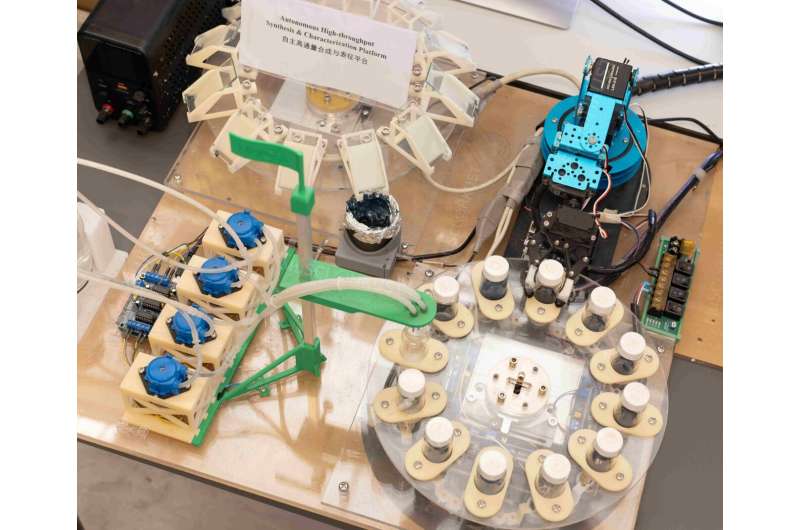
Researchers at the Hong Kong University of Science and Technology have developed a modeling and optimization method for designing automated materials laboratories before expensive equipment is purchased. The approach could make high-throughput materials experimentation more accessible by helping engineers determine the right combination of instruments for a given workflow, budget, space, and throughput target, tells Tech Xplore.
Modularized autonomous experimentation platforms automate tasks such as sample preparation, synthesis, characterization, and screening. They can accelerate materials discovery, improve experimental repeatability, and generate structured datasets. However, deciding which equipment to buy and how many units are required can be complicated and costly.
The researchers address this problem with a framework inspired by hybrid automata, a mathematical approach for representing systems that move between different states. Experimental workflows are translated into procedure states, transitions, timing requirements, and equipment usage. An equipment dictionary records information such as instrument functions, operating parameters, cost, footprint, and dependencies.
The resulting equipment-selection problem is treated as a constrained integer nonlinear optimization problem. An integer-coded differential evolution algorithm searches possible configurations while considering budget, available space, throughput requirements, and equipment relationships. This allows designers to evaluate potential bottlenecks and resource utilization before committing to hardware.
The team demonstrated the method using a thermal insulation coating experiment on a compact 0.54 m2 desktop laboratory with a budget of about $11,000. For a three-sample batch, automation reduced active operator time by 79.1%, from 1,589.7 seconds to 331.8 seconds. The automated process also produced more consistent light-transmittance measurements.
The researchers now plan to incorporate equipment layout, dynamic scheduling, and closed-loop AI decision-making. Their longer-term goal is a Materials Operating System, or MaterOS, that could provide a broader foundation for automated materials experimentation.
