

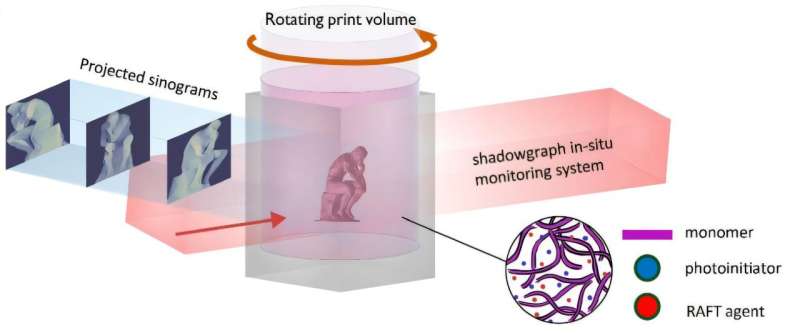
Researchers at the University of Nottingham, working with collaborators at the University of California, Berkeley, have developed a new approach that addresses one of the biggest challenges in volumetric additive manufacturing (VAM): excessive heat generated during printing, tells Phys.org. Their technique improves the stability of the process while preserving its ability to fabricate complete three-dimensional objects in seconds or minutes. Published in Nature Communications, the research could broaden the industrial and biomedical use of volumetric 3D printing by making the technology more reliable, scalable, and versatile.
Unlike conventional additive manufacturing, which builds parts layer by layer, VAM uses projected light patterns to solidify an entire object simultaneously within a vat of liquid resin. This enables exceptionally fast production, complex geometries, and parts without the weak interlayer bonds commonly found in traditional 3D printing. However, the rapid polymerization process generates significant heat, which can trigger thermal instabilities, distort printed components, and limit the size and complexity of printable objects.
To overcome these limitations, the researchers incorporated Reversible Addition–Fragmentation Chain Transfer (RAFT) polymerization into the resin formulation. The modified chemistry regulates the polymerization reaction, preventing sudden heat spikes and creating a more controlled curing process. Testing showed substantially lower temperature buildup, fewer printing defects, and improved dimensional accuracy. The enhanced process also enabled multiple components to be printed simultaneously with gaps of approximately 150 micrometers, a significant improvement over conventional VAM. Beyond stabilizing the manufacturing process, the RAFT chemistry leaves reactive sites within the printed material, allowing engineers to add functional surface treatments, including antibacterial and anti-fouling coatings, after fabrication.
The researchers believe the breakthrough represents a significant step toward expanding volumetric 3D printing into real-world applications. Potential uses include rapid production of customized medical devices, advanced bioprinting, and complex engineering components that require both speed and precision. Future work will focus on scaling the technology for larger parts and industrial manufacturing while exploring additional functional materials. By improving both process stability and material versatility, the new technique brings volumetric additive manufacturing closer to widespread commercial adoption without sacrificing its hallmark speed or geometric freedom.
