

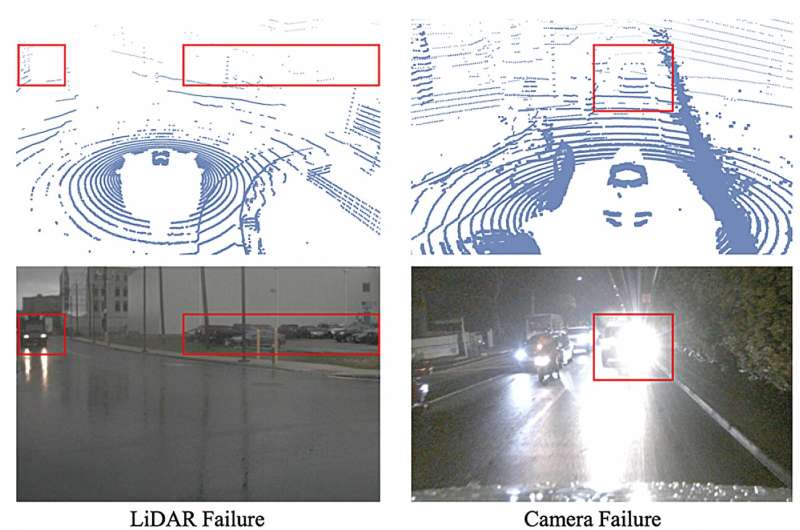
Self-driving vehicles commonly combine cameras and LiDAR to understand their surroundings. Cameras provide color, texture, and object outlines, while LiDAR measures precise distances using laser pulses. Together, the sensors improve perception, but their reliability can shift dramatically with weather, lighting, and location, tells Tech Xplore.
Researchers at the Singapore University of Technology and Design have developed two AI approaches to make multimodal perception more adaptable. Led by assistant professor Zhao Na, the studies address a key problem: systems trained mainly under clear daytime conditions can develop a strong preference for one sensor, leaving them vulnerable when conditions change.
The first method, Complementary Collaborative Fusion, or CCF, tackles an underlying LiDAR bias. Researchers found that during training, LiDAR-generated object candidates were matched to real objects 37.5 times more often than camera candidates. CCF gives each sensor its own training signal, supplements camera candidates with LiDAR depth information, and selectively masks portions of training data so the model must learn from both sensors.
Testing on the nuScenes autonomous-driving data set showed improvements in mean average precision of 2.8 percentage points in rain, 1.3 points at night, and 3.2 points on Boston test data, without sacrificing daytime performance.
The second approach, PanDA, helps perception systems adapt to unfamiliar environments without requiring manually labeled data. It generates provisional labels and refines them using two expert systems. A 3D expert uses LiDAR geometry to repair fragmented regions, while a 2D expert uses pretrained vision models to correct uncertain object classifications.
PanDA produced substantial gains when transferring between cities, weather conditions, and lighting environments. The researchers caution, however, that both methods require broader real-world validation before deployment. Future systems will need to determine dynamically which sensor information is most trustworthy rather than relying on fixed assumptions about rain, darkness, or unfamiliar surroundings.
