

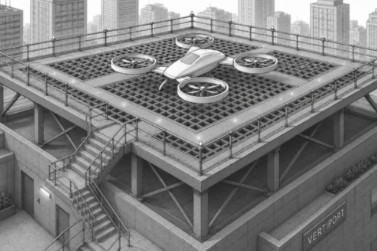
As electric vertical takeoff and landing aircraft, or eVTOLs, move closer to commercial service, reducing noise has become one of the biggest engineering challenges. While much attention has focused on quieter aircraft designs, researchers at the University of Bristol argue that the landing infrastructure itself can play an equally important role. Their latest study demonstrates that redesigning vertiport landing pads with perforated surfaces could substantially reduce the noise generated during takeoff and landing, making air taxis more suitable for use in densely populated cities.
The research examines ground effect, a phenomenon that occurs when rotorcraft operate close to the ground. As rotor downwash strikes a solid surface, high-pressure air builds beneath the aircraft, amplifying rotor noise and creating louder acoustic reflections. Instead of relying on conventional solid landing pads, the researchers tested perforated surfaces that allow some of the airflow to pass through the openings. This reduces pressure buildup while also limiting the amount of sound reflected toward the aircraft and the surrounding environment.
The results were significant. Perforated landing surfaces reduced blade-generated noise by as much as 15 decibels and lowered overall sound pressure levels by up to 7 decibels. According to the researchers, the openings interrupt the aerodynamic processes responsible for noise amplification while dissipating part of the airflow that would otherwise rebound from a solid surface.
The study highlights the need to treat aircraft and infrastructure as a single engineering system rather than designing each independently. Future vertiports, rooftop landing pads, and drone delivery hubs could incorporate elevated grid-like structures that improve acoustic performance without requiring major changes to aircraft designs.
Beyond improving passenger comfort, quieter operations could strengthen public acceptance of urban air mobility, one of the key barriers to widespread adoption. The findings suggest that thoughtful infrastructure design can complement advances in electric propulsion and rotor technology, helping cities integrate air taxis and drones with fewer disruptions while supporting the long-term growth of advanced aerial transportation.
