

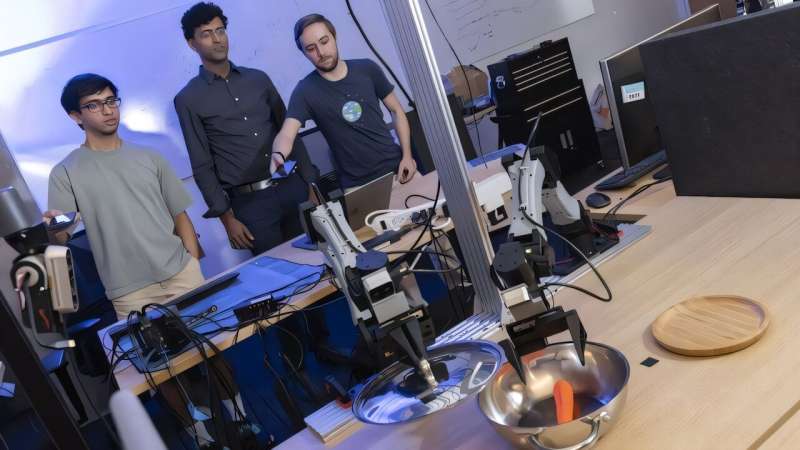
Researchers at the Georgia Institute of Technology have developed a smartphone application called COBALT that could significantly lower the barriers to operating robots. The system allows users with little or no robotics experience to control a robotic arm remotely using a standard smartphone, potentially from anywhere in the world. The research was presented at the IEEE International Conference on Robotics and Automation in Vienna, tell Tech Xplore.
COBALT transforms a smartphone into an intuitive robot controller. After connecting securely to a server over Wi-Fi, users simply move their phones, and the robotic arm mirrors those movements in real time. Additional touchscreen controls allow users to grasp, move, and release objects, creating an experience similar to operating a mobile game. According to the researchers, this approach eliminates many of the technical hurdles traditionally associated with robotic systems.
The project was led by Ayush Agarwal, a doctoral student in Georgia Tech’s School of Interactive Computing. To evaluate the platform, the research team conducted user studies involving participants from nine countries. These users remotely controlled robot arms located in Georgia Tech’s People, AI & Robotics (PAIR) Lab, demonstrating that complex robotic tasks can be performed effectively through a familiar consumer device.
The technology has implications far beyond laboratory demonstrations. Remote robot operation could expand access to manufacturing, warehouse logistics, hazardous-environment work, and teleoperation applications. By allowing individuals to interact with robots through devices they already own, the system could help organizations deploy robotic capabilities without requiring extensive operator training or specialized hardware.
The research reflects a broader trend toward democratizing robotics through user-friendly interfaces. Rather than requiring expertise in programming or robotics engineering, COBALT leverages the sensors, connectivity, and familiarity of smartphones to create a more accessible control platform. If adopted at scale, such systems could accelerate the use of robots across industries by making advanced robotic tools available to a much wider range of users.
