

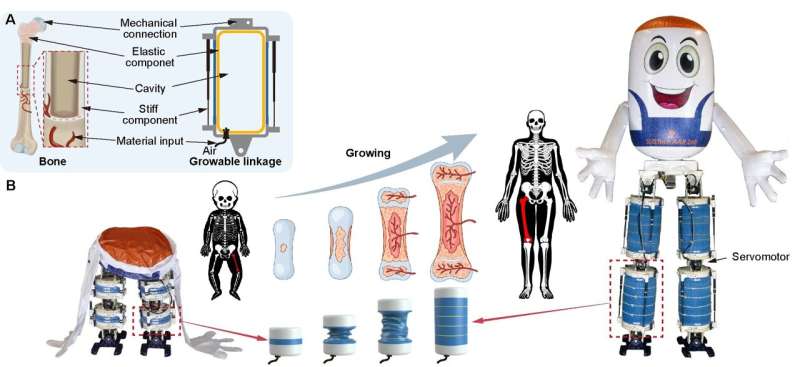
A team of researchers at Southern University of Science and Technology in Shenzhen has unveiled a soft humanoid robot that stretches the boundaries of conventional robotics by combining growable limbs, buoyancy, and flight capability. Named GrowHR, this robot uses a network of inflatable chambers linked with tensioned cables, carbon-fiber guides, and small motors to adapt its shape and size for different tasks and terrains, tells Tech Xplore. This design lets it expand to more than three times its original height or shrink to fit through narrow spaces, giving it remarkable physical versatility.
Weighing around 4.5 kg, GrowHR’s lightweight frame enables it to float and walk across water and even swim with minimal propulsion. When paired with small fans or quad-rotor support, the robot can lift off and fly short distances, a striking departure from typical rigid humanoids that are limited to ground locomotion. Its soft structure also makes it inherently safer in environments where collisions might otherwise injure people or damage machinery.
The robot’s morphology draws inspiration from natural biology, especially the way bone and soft tissues balance strength and flexibility in animal limbs. Each growable segment consists of an expandable chamber surrounded by a nonstretchable textile and an internal cable system that ensures smooth extension and retraction. Coordinated actuation with embedded motors lets the robot transition fluidly between standing, crawling, and other movement modes.
Beyond sheer novelty, GrowHR points toward a future where robots can perform tasks in environments that are confined, dynamic, or hazardous, such as disaster zones, collapsed buildings, or industrial settings with unpredictable obstacles. Its combination of mobility modes, from walking and crawling to floating and airborne movement, makes it a true all-terrain platform.
Researchers published the details of GrowHR’s design and performance in Science Advances, highlighting not only its multifunctional capability but also the potential for soft robotics to deliver adaptable, environment-aware systems that overcome many limitations of traditional rigid machines.
