

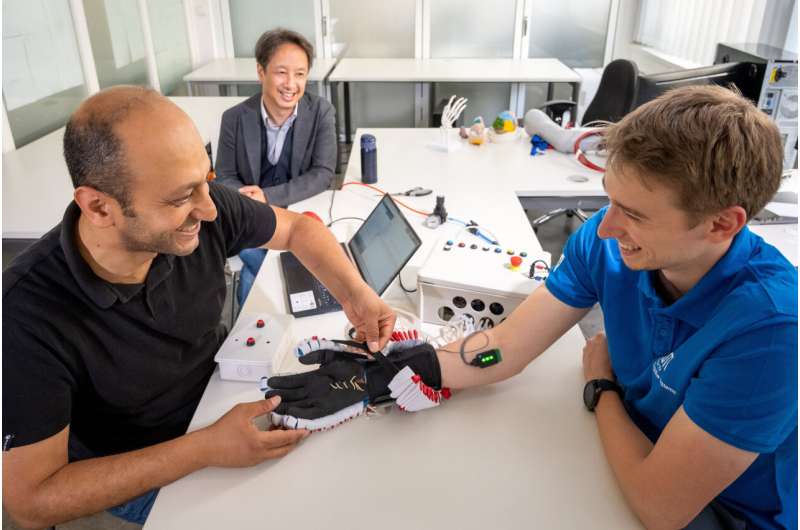
Researchers at the Technical University of Munich and the Center for Rehabilitation Passauer Wolf have developed a lightweight soft robotic exoskeleton that could restore hand function in people with severe motor impairments. Described in a study published in Nature Machine Intelligence, the wearable system combines soft robotics, muscle sensing, and artificial intelligence to help users perform everyday tasks that would otherwise be impossible, tells Tech Xplore.
Unlike many existing hand exoskeletons, which require users to retain partial control of their fingers, the new device is designed for individuals with profound loss of hand movement caused by conditions such as amyotrophic lateral sclerosis (ALS) or stroke. Built from fabric using conventional sewing techniques, the glove is lightweight, flexible, and pneumatically actuated, making it more comfortable and safer than traditional rigid robotic devices.
A key innovation lies in the system’s control mechanism. Sensors embedded in the glove detect faint electrical signals generated by the wearer’s hand muscles, even when visible movement is no longer possible. A machine learning model interprets these signals to predict the user’s intention to grasp an object. The glove then inflates its pneumatic actuators to assist the desired movement, enabling users to pick up and manipulate everyday items.
The researchers evaluated the technology with one patient who had experienced almost complete hand paralysis due to ALS and six stroke survivors with severe hand impairments. Participants completed standard clinical assessments, including the Box and Block Test and the Action Research Arm Test. Results showed meaningful improvements in hand function, demonstrating that the exoskeleton could support tasks requiring coordinated grasping and object manipulation. In one striking demonstration, an ALS patient who had been unable to use his right hand for approximately four years successfully picked up a fork and fed himself a piece of cake.
The research highlights the growing role of AI in assistive robotics. Rather than simply amplifying movement, the exoskeleton interprets the user’s intent and converts weak biological signals into functional hand actions. While additional clinical testing is needed before widespread adoption, the technology represents a promising advance in rehabilitation engineering and assistive care, offering new opportunities to restore independence and improve quality of life for people living with severe neurological disorders or motor impairments.
