

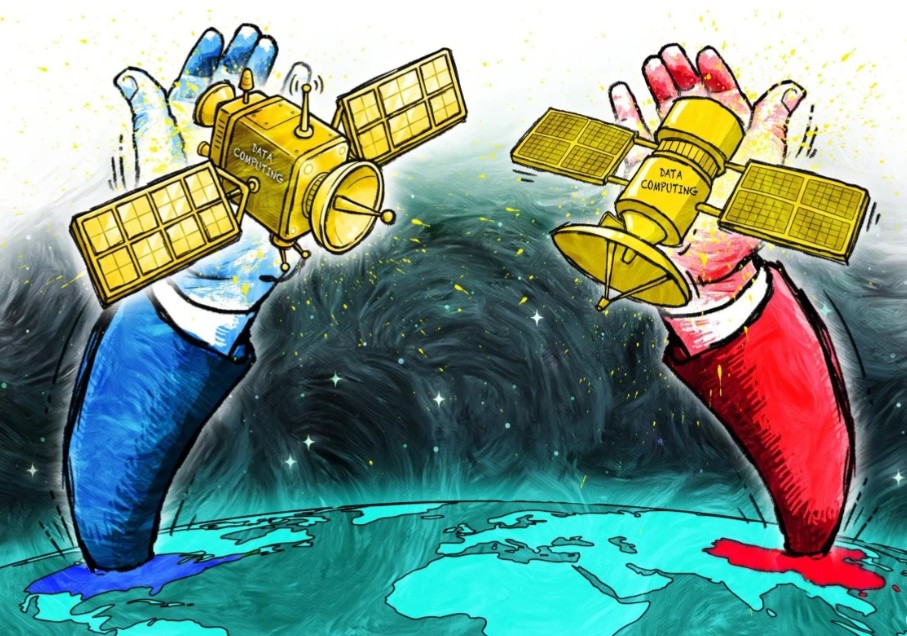
The competition between the United States and China is expanding beyond terrestrial networks and satellite communications into a new arena: space-based computing. Rather than relying solely on satellites to transmit information back to Earth for processing, researchers and technology companies are exploring ways to perform computing tasks directly in orbit. This concept, often described as a “cloud above the clouds,” could transform how data is handled in space while reducing the burden on ground-based infrastructure, says South China Morning Post.
The article explains that modern satellites generate enormous volumes of data from Earth observation, communications, scientific research, and military operations. Traditionally, this information must be transmitted to ground stations for processing, creating bottlenecks that consume bandwidth and introduce delays. Space-based computing seeks to overcome these limitations by equipping satellites with advanced processors capable of analyzing, filtering, and interpreting data before it is sent to Earth.
China has emerged as a particularly active participant in this field. The country is developing an orbital computing infrastructure designed to support artificial intelligence applications and large-scale data processing in space. Chinese researchers view the technology as a strategic opportunity to strengthen national capabilities in both space exploration and digital infrastructure. At the same time, American companies and government agencies are pursuing similar initiatives, motivated by growing demand for AI computing power and concerns about future capacity constraints in terrestrial data centers.
Advocates argue that orbital computing could offer several advantages. Space-based systems have access to abundant solar energy, potentially reducing dependence on electricity-intensive terrestrial data centers. Processing information closer to where it is collected could also improve efficiency for remote sensing, environmental monitoring, defense applications, and deep-space missions.
Significant technical hurdles remain, including radiation protection, thermal management, reliable communications, and the high cost of launching computing hardware into orbit. Nevertheless, supporters believe these challenges will become more manageable as launch costs decline and satellite technologies mature.
The emerging race to build computing infrastructure in space reflects a broader shift in digital technology. Just as cloud computing transformed information processing on Earth, orbital computing may become the next platform shaping the future of data, artificial intelligence, and global technological competition.
