

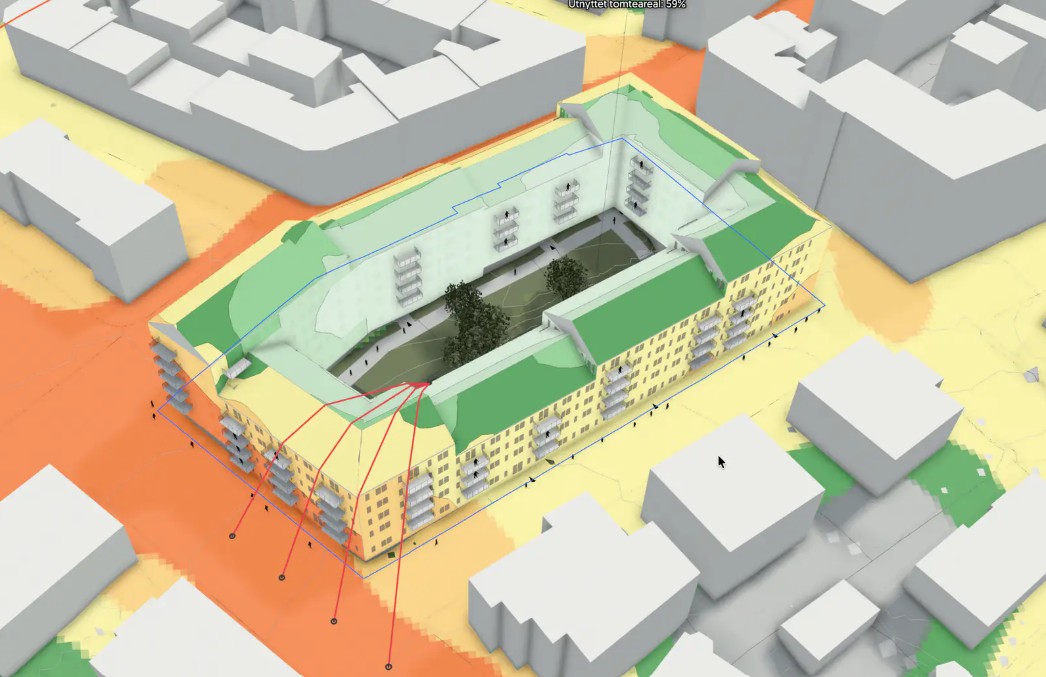
Spacio’s Traffic Noise beta brings acoustic feedback into early building design, when changing a project’s shape and layout is still affordable. The Spacio article argues that conventional noise reports often arrive after building massing is settled, leaving architects to compensate with expensive glazing, ventilation, or revised floor plans.
The tool focuses on practical decisions: whether buildings have a quiet side, which facades suit bedrooms, and where nighttime noise permits open windows. Results use national guidance for Norway, Sweden, and Denmark, with the World Health Organization’s guideline elsewhere. Nighttime exposure is assessed against the WHO’s 45-decibel recommendation.
Users place a study area around their buildings and review nearby transport sources. Street inputs include speed, daily traffic volume, and heavy-vehicle share. Norway’s national road database supplies counts where available; other locations rely on street-type defaults unless users provide data. Railway and tram sources can also be adjusted.
Results appear across ground surfaces, facades, roofs, and individual spaces. An inspection mode traces sound paths and identifies the roads contributing most to exposure. Architects can then test changes such as closing courtyard gaps, raising roadside blocks, or rotating buildings. Additional scenarios examine speed reductions, soft ground, quieter asphalt, and absorptive facades, with assumptions identified.
Spacio uses the CNOSSOS-EU assessment method. The company reports passing seven reference tests and matching NoiseModelling closely on a shared test scene. Comparisons with consultants’ models were typically within three decibels, but no field measurements have validated the tool.
The beta also compares results with official noise maps in selected locations. However, it provides early design guidance rather than compliance certification, excludes aircraft and industrial noise, and does not model maximum nighttime levels. It requires a WebGPU-capable browser. Its purpose is to help architects bring better layouts to acoustic consultants, reducing costly surprises before detailed design decisions become difficult to reverse.
