

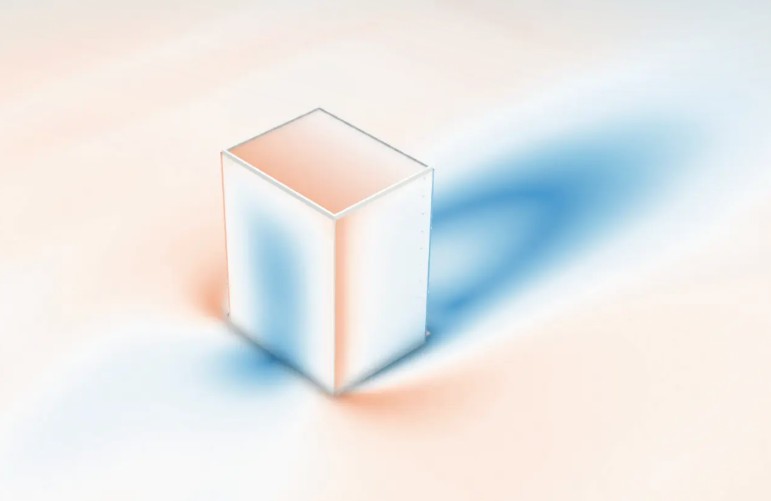
Spacio has tested its wind analysis tool against established wind tunnel experiments to determine how accurately it predicts pedestrian-level wind conditions around buildings. The results highlight its potential for early architectural design while identifying limitations that engineers and architects must consider.
The company evaluated its existing software against four experiments published by the Architectural Institute of Japan. These included an isolated building, a thin slab, a tower surrounded by low-rise buildings, and an empty wind tunnel used to verify incoming airflow.
Spacio creates a virtual wind tunnel around a proposed development, incorporating buildings, surrounding structures, trees, and terrain. Its computational grid uses finer cells near pedestrian areas, measuring wind conditions at approximately 1.5 meters above ground. Weather records and surrounding urban conditions inform simulations across 12 wind directions.
The benchmarks showed that the tool accurately identifies wind acceleration around building corners and sheltered areas. Its predictions at high-speed locations fall within accepted computational fluid dynamics tolerances, making it useful for comparing alternative building configurations.
However, the testing exposed several weaknesses. Sheltered locations appear windier than actual measurements suggest, while streets within dense urban developments register lower wind speeds than expected. The software also simplifies airflow behind buildings and fails to reproduce certain rooftop recirculation patterns.
Additional limitations remain unvalidated, including hillside airflow, tree canopy effects, facade pressures, and oblique winds. Buildings exceeding 100 meters are truncated during simulation, restricting accuracy for tall structures and dense high-rise districts.
Spacio emphasizes that its tool supports comparative design decisions rather than certified wind assessments. Architects can use it to evaluate building orientation, massing, pedestrian comfort, and entrance placement while designs remain flexible.
For engineering professionals, the findings demonstrate the value of integrating wind analysis into early design workflows without replacing detailed, project-specific assessments required for regulatory approval.
