
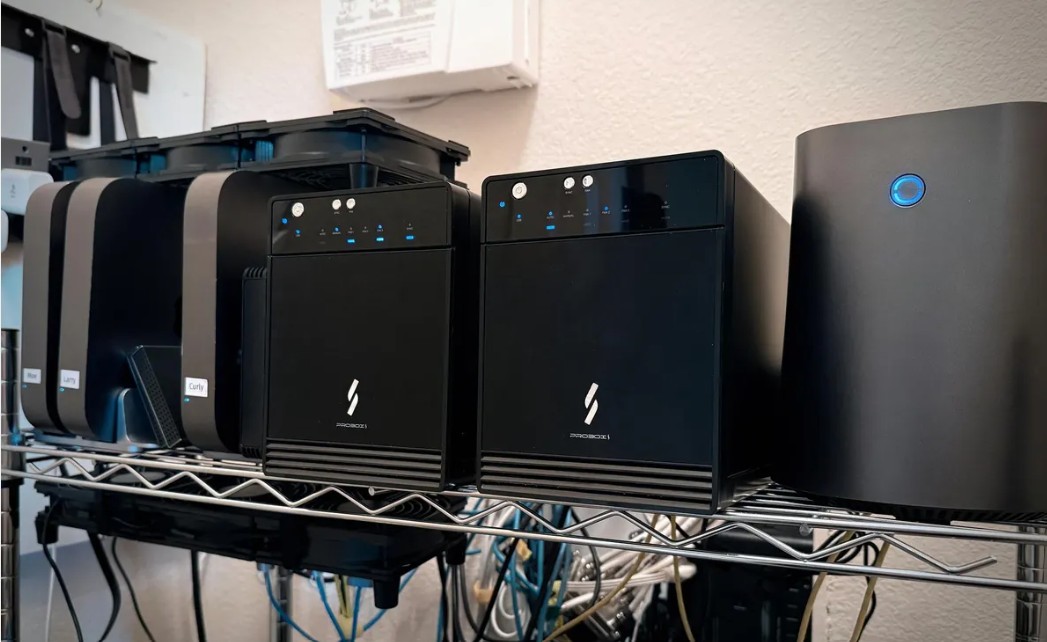
AI companies are exploring an alternative to running every artificial intelligence workload in massive data centers: using spare computing power already available in homes and small businesses. Several startups are building distributed networks that allow owners of servers, gaming PCs, and even underused laptops to provide computing resources for AI inference and receive payment, tells IEEE Spectrum.
Companies including Far Labs and Evolving Edge are developing platforms that coordinate these geographically dispersed devices. Bless Network, Salad, and Gradient are pursuing similar approaches. The concept resembles earlier distributed-computing projects such as SETI@Home, but applies the model commercially to AI.
Security is a central challenge. Evolving Edge has open-sourced its node scheduling software so hosts can inspect its operation. Far Labs uses a least-privilege approach in which inference workloads operate in isolation with encrypted communications and defined limits on GPU, CPU, memory, storage, and network access. Hosts can monitor resource use and disconnect their machines.
Distributed computing also presents technical difficulties because consumer hardware is less powerful and consistent than data-center infrastructure. Smaller, task-specific open-source AI models can often run on individual devices. For larger workloads, models can be divided across multiple GPUs or CPUs. Evolving Edge uses the open-source Ray framework, while Far Labs has developed software that distributes model segments among devices and coordinates their outputs.
The companies argue that this approach can lower inference costs because it uses existing hardware rather than requiring new data-center investment. Distributed networks could also improve resilience because workloads are not dependent on one facility.
Routing tasks to nearby computers may reduce latency as well. Far Labs claims latency of 100 milliseconds or less. Such performance could eventually support demanding applications including real-time AI video generation for games.
Large data centers will remain important, particularly for training frontier models. But distributed computing could provide a complementary infrastructure for smaller models and specialized inference while turning currently idle computing hardware into a usable AI resource.
