

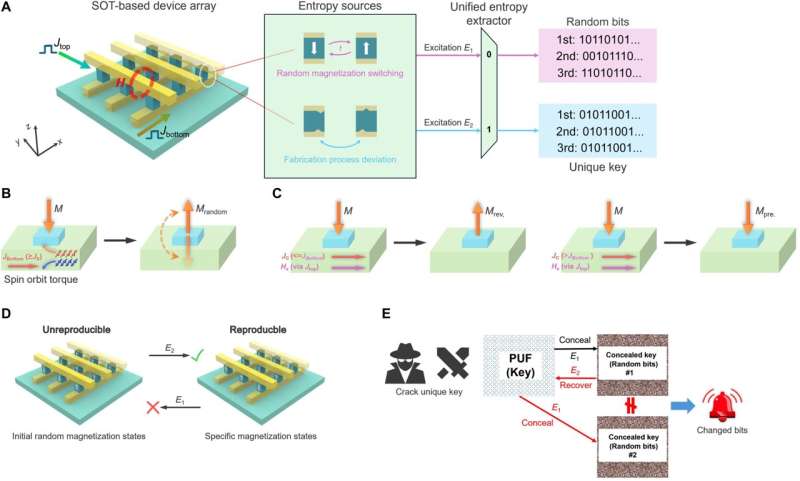
As digital devices exchange increasing amounts of sensitive information, protecting cryptographic keys remains one of the most important challenges in cybersecurity. Conventional hardware security systems typically rely on monitoring power consumption, electrical signals, or environmental changes to detect attacks. However, sophisticated attackers can sometimes bypass these defenses. Researchers at Huazhong University of Science and Technology and Hubei University have now developed a hardware security system that integrates key generation, key storage, key concealment, and attack detection into a single platform based on spin-orbit torque (SOT) devices, tells Tech Xplore.
The system takes advantage of the unique properties of SOT Hall devices, which use both electrical charge and electron spin. When electrical current is applied, the devices can randomly switch between magnetic states. This unpredictable behavior enables them to function as true random number generators, creating unique cryptographic keys. At the same time, unavoidable manufacturing variations give each device distinct characteristics, allowing them to serve as physically unclonable functions that generate device-specific security credentials.
A key innovation of the research is the integration of these two sources of randomness within the same hardware component. Unlike conventional nonvolatile memory systems that store keys in a fixed state, the SOT devices remain in a random state when idle and contain no extractable key information. Retrieving a valid key requires a specific excitation signal that moves the device into a deterministic state. Because this transition irreversibly alters the original magnetic configuration, any attempt to access the key permanently changes the device.
This creates a hardware-rooted security mechanism in which key access itself becomes a detectable event. Unauthorized attempts to extract information leave irreversible traces that can be identified later without requiring additional monitoring circuitry.
The researchers believe the technology could be particularly valuable for Internet of Things devices, smart sensors, portable security tokens, and other resource-constrained hardware deployed in exposed environments. Future work will focus on scaling the technology, integrating it with standard CMOS manufacturing processes, and exploring advanced security functions such as self-destruction of sensitive data and autonomous responses to attacks.
