

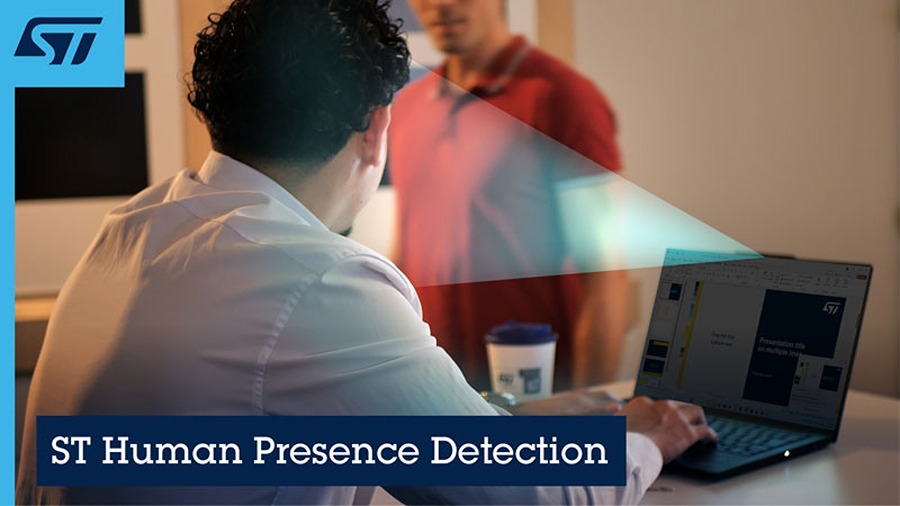
GENEVA, Switzerland, June 27, 2025 – STMicroelectronics has introduced a Human Presence Detection (HPD) technology for laptops, PCs, monitors, and accessories that combines FlightSense Time-of-Flight (ToF) sensors with AI algorithms. The system reduces daily power consumption by over 20% while supporting features like hands-free Windows Hello authentication, extended battery life, and privacy or wellness notifications. The solution is designed to improve energy efficiency, security, and user interaction without relying on camera-based systems.
“Building on the integration of ST FlightSense technology in more than 260 laptops and PC models launched in recent years, we are looking forward to see our new HPD solution contributing to make devices more energy-efficient, secure, and user-friendly,” said Alexandre Balmefrezol, executive vice president and general manager of the Imaging sub-group at STMicroelectronics. “As AI and sensor technology continue to advance, with greater integration of both hardware and software, we can expect to see even more sophisticated and intuitive ways of interacting with our devices, and ST is best positioned to continue to lead this market trend.”
“Since 2023, 3D sensing in consumer applications has gained new momentum, driven by the demand for better user experiences, safety, personal robotics, spatial computing, and enhanced photography and streaming. Time-of-Flight (ToF) technology is expanding beyond smartphones and tablets into drones, robots, AR/VR headsets, home projectors, and laptops. In 2024, ToF modules generated $2.2 billion in revenue, with projections reaching $3.8 billion by 2030 (9.5% CAGR). Compact and affordable, multizone dToF sensors are now emerging to enhance laptop experiences and enable new use cases,” said Florian Domengie, PhD principal analyst, imaging at Yole Group.
The 5th Generation Turnkey ST Solution
The ST solution integrates hardware and software, combining the FlightSense 8×8 multizone Time-of-Flight sensor (VL53L8CP) with AI-based algorithms to enable functions such as human presence detection, multi-person detection, and head orientation tracking. Designed as a turnkey system for OEMs, it requires no additional development. 5th generation of sensors also supports gesture recognition, hand posture detection, and wellness monitoring through human posture analysis.
ST’s Human Presence Detection (HPD) solution enables enhanced features such as:
- Adaptive Screen Dimming tracks head orientation to dim the screen when the user isn’t looking.
- Walk-Away Lock & Wake-on-Attention automatically locks the device when the user leaves and wakes up upon return
- Multi-Person Detection alerts the user if someone is looking over their shoulder.
Tailored AI Algorithm
STMicroelectronics developed an AI-based workflow that includes data collection, labeling, cleaning, model training, and integration into a market product. The process used data logs from various sources. These logs included personal seating and movement data contributed by employees over several months, which helped refine the AI algorithms through repeated testing.
One achievement is the transformation of a Proof-Of-Concept (PoC) into a solution capable of detecting a laptop user’s head orientation using 8×8 pixels of distance data. This success was driven through a development process that included four global data capture campaigns, 25 solution releases, and quality control of AI training data. The approach also involved a pre-processing method for VL53L8CP ranging data, and the design of four AI networks: Presence AI, HOR (Head Orientation) AI, Posture AI, and Hand Posture AI. Central to this accomplishment was the VL53L8CP ToF sensor, engineered to optimize the Signal-To-Noise ratio (SNR) per zone.
Enhanced User Experience & Privacy Protection
The ToF sensor ensures user privacy without capturing images or relying on the camera, unlike previous versions of webcam-based solutions.
Adaptive Screen Dimming:
- Uses AI algorithms to analyze the user’s head orientation. If the user is not looking at the screen, the system gradually dims the display to conserve power.
- Extends battery life by minimizing energy consumption.
- Optimizes for low power consumption with AI algorithms and can be integrated into existing PC sensor hubs.
Walk-Away Lock (WAL) & Wake-on-Approach (WOA):
- The ToF sensor locks the PC when the user moves away and wakes it upon their return, eliminating the need for manual interaction.
- This feature enhances security, safeguards sensitive data, and offers a hands-free user experience.
- Advanced filtering algorithms help prevent false triggers, ensuring the system remains unaffected by casual passerby.
Multi-Person Detection (MPD):
- The system detects multiple people in front of the screen and alerts the user if someone is looking over their shoulder.
- Enhances privacy by preventing unauthorized viewing of sensitive information.
- Advanced algorithms enable the system to differentiate between the primary user and others.
- AI-based: compact, low-power algorithms suitable for integration into PC sensor hubs.
- A complete solution includes ToF sensor and AI algorithms.
Source: STMicroelectronics
About STMicroelectronics

STMicroelectronics, established in 1987 through the merger of Italy’s SGS Microelettronica and France’s Thomson Semiconducteurs, is a global semiconductor company headquartered in Geneva, Switzerland. The company offers a range of products, including analog chips, discrete power semiconductors, microcontrollers, and sensors, serving industries such as automotive, industrial, personal electronics, communications equipment, and computers. In 2023, STMicroelectronics reported revenues of $17.3 billion, with over 50,000 employees worldwide and offices in 40 countries. The company is committed to sustainability, aiming for carbon neutrality in scope 1 and 2 emissions, and partially scope 3, by 2027.
