

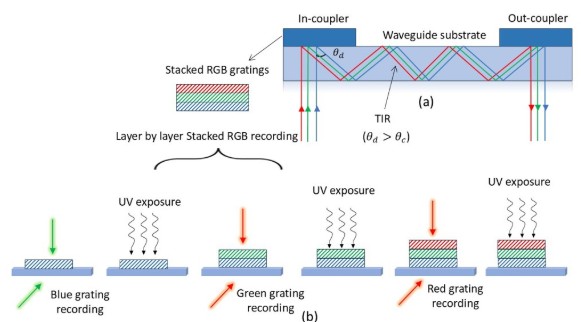
Researchers have developed a full-color near-eye display that could help make augmented reality glasses brighter, lighter, and more energy efficient. The design uses three stacked holographic gratings engineered separately for red, green, and blue light, improving the efficiency with which digital images reach the viewer’s eye, tells Optica.
Holographic gratings are microscopic optical structures that precisely redirect light. In AR displays, they can couple light into and out of transparent waveguides, allowing virtual images to appear over the real-world view. Existing full-color holographic waveguides can record all three RGB gratings in a single photopolymer layer, but this reduces diffraction efficiency and can produce dimmer images. Conventional fabrication can also require bulky prisms that complicate manufacturing.
Researchers from Central Scientific Instruments Organisation (CSIR) and the Academy of Scientific and Innovative Research in India developed a prism-free method that records each color grating separately in photopolymer film and stacks the layers during fabrication. This approach maintains alignment while allowing each color channel to be optimized independently. The resulting improvement in light efficiency can produce brighter images without increasing input power, potentially reducing battery requirements for AR glasses.
The team demonstrated the technology by incorporating stacked RGB gratings into a transparent glass waveguide as input and output couplers. Tests with a miniature digital display successfully produced bright red, green, blue, and full-color images.
The researchers see potential applications in navigation, education, medical visualization, industrial assistance, maintenance, and training. The technique could also be extended to larger systems such as automotive head-up displays.
Further development will focus on expanding the field of view and improving color uniformity. Commercialization will require integration into eyeglasses-like prototypes and testing for brightness, image quality, power consumption, eye comfort, and long-term reliability.
