

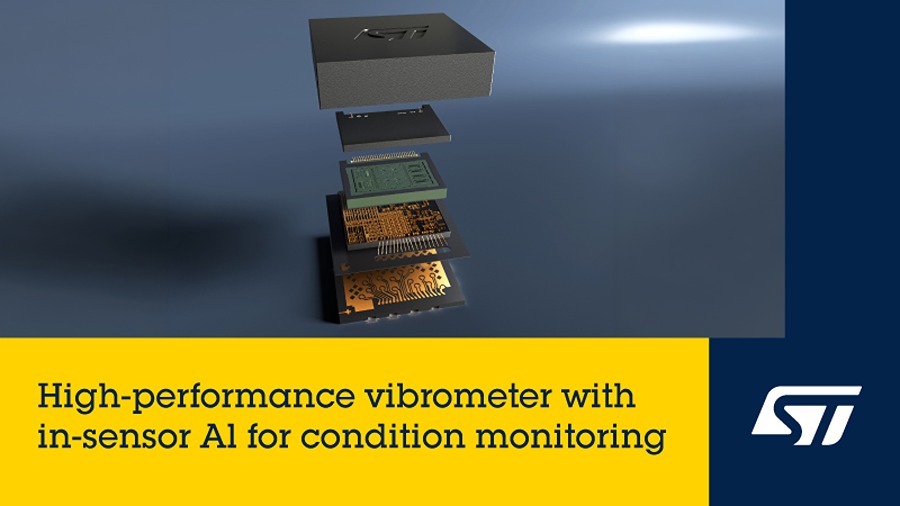
GENEVA, Switzerland, June 5, 2026 – STMicroelectronics (STM) introduced the IIS3DWB10IS, a MEMS vibration sensor that moves vibration analysis closer to industrial machinery. The device combines high-g shock measurement, digital signal processing and AI inference for condition-monitoring systems that require accuracy, reliability and low energy use.
Built using ST MEMS (Micro Electromechanical Systems) technology, the sensor includes an intelligent sensor processing unit (ISPU 2.0) near the sensing element. It measures vibration and shocks up to 200g at frequencies of 10 kHz and above, and operates in industrial environments up to 125°C. The device supports predictive maintenance workflows by processing vibration data used to track equipment condition, uptime and unplanned downtime risk.
“Our industrial MEMS vibration sensor delivers the dynamic range and bandwidth needed for high-end applications and extends the advantages of ST in-sensor digital processing. Integrating the ISPU 2.0, with its new hardware accelerators for fast signal processing and AI inference, sharpens equipment-wear recognition while reducing latency and power consumption,” said Simone Ferri, APMS executive VP MEMS sub-group. “Industries can expect a new generation of condition monitoring sensors, the first compelling alternative to piezosensor, that is lightweight, easy to fit and design, ultra-accurate, and energy efficient enough for battery-powered operations.”
“The IIS3DWB10IS delivers unique properties for our target markets and environments. Its high dynamic range, wide bandwidth, and high-temperature capability, combined with ease of adoption and a cost-effective, simplified circuit design, allowed us to replace the incumbent piezosensor technology. Moreover, the integrated ISPU 2.0 processor positions complex signal processing and rapid AI inference close to the sensing element, enabling smarter system responses,” said Andrea Torcelli, chief technology officer at Bonfiglioli S.P.A.
Features of the IIS3DWB10IS
- Digital Vibration Sensing: The IIS3DWB10IS is a digital vibration sensor with wide bandwidth and embedded processing. It is designed for industrial condition monitoring applications.
- Piezoelectric Sensor Alternative: The sensor offers accuracy and sensitivity comparable to piezoelectric sensors. It adds digital-sensing advantages, including smaller size, lower power use and simpler electrical and mechanical design.
- High-Frequency Measurement: The device measures vibrations above 10 kHz and supports a range up to 200g. It also delivers a noise floor as low as 35 µg/√Hz.
- On-Device Processing: The sensor includes ISPU 2.0. It performs real-time signal processing and AI at the edge, close to the sensing element.
- Hardware Acceleration: ISPU 2.0 uses hardware accelerators for frequently used processing functions. These accelerators improve execution speed and reduce power use.
- Programmable Architecture: The ISPU 2.0 core is C-programmable and includes on-chip program and data RAM. This gives developers control over computational partitioning.
- Algorithm Support: ST provides software libraries for vibration monitoring algorithms. Supported functions include FFT, filtering, envelope, velocity severity and anomaly detection.
- Processing Performance: ISPU 2.0 delivers 40 MIPS and 40 MFLOPS of digital signal processing. It provides up to 4x times the processing performance of the previous generation and supports 6x times faster data transfer with the MEMS circuitry.
- Integrated Sensor Functions: The IIS3DWB10IS includes a 2048×80-bit FIFO register and temperature sensor. Its design supports operation up to 125°C.
- Package and Availability: The sensor is packaged in a 4.5 mm × 4.5 mm × 1.5 mm 16-lead LGA package with wettable flanks for automatic optical inspection. It is supported by ST’s 10-year industrial longevity program.
The product is scheduled to be available by July 2026 from $25 for orders of 1000 pieces.
Source: STMicroelectronics
About STMicroelectronics

STMicroelectronics (ST) is a semiconductor company founded in 1987. It designs and manufactures microcontrollers, sensors, power devices and other analog and mixed-signal components. The company operates as an integrated device manufacturer with in-house production that supports large-volume supply for global markets. Its customers include automotive, industrial, consumer electronics and communications equipment manufacturers. ST also works with technology partners to develop components used in mobility systems, energy and power management equipment and connected devices. The company reports ongoing efforts to reduce emissions across its operations and increase the share of renewable electricity in its manufacturing sites, with a goal to reach full renewable sourcing by 2027. ST is headquartered in Geneva, Switzerland. It serves more than 200,000 customers worldwide and employs about 50,000 people. Its technologies support applications that require efficient power conversion, sensing, processing and connectivity. The company expands its portfolio to support automotive, industrial, consumer and connected system applications through integrated design and manufacturing.
