

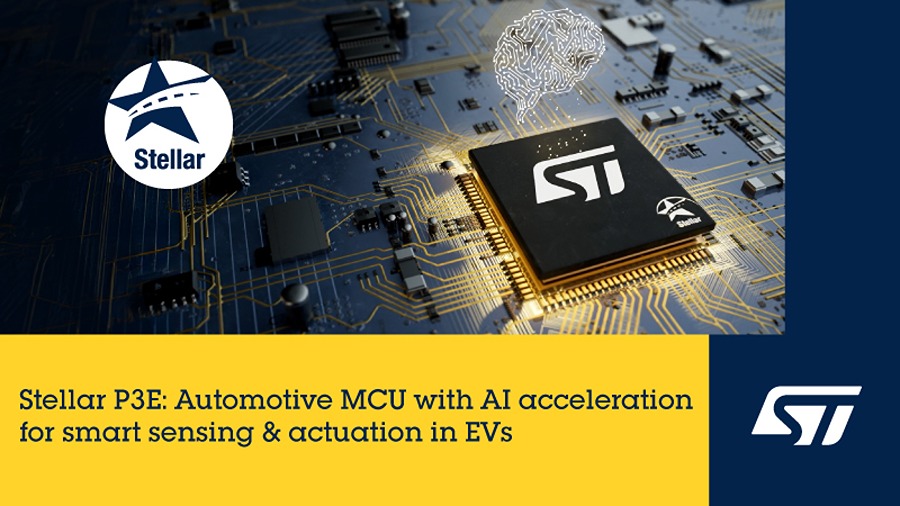
GENEVA, Switzerland, Feb 11, 2026 – STMicroelectronics announced the Stellar P3E, an automotive MCU built for X in 1 ECU designs. It supports multi-function integration to reduce system cost, weight, and complexity. Stellar P3E integrates the ST Neural-ART Accelerator to improve AI efficiency. STMicroelectronics said it is the first automotive MCU with an embedded neural network accelerator. Its neural processing unit (NPU) uses an advanced data-flow architecture for AI workloads. With sensing support, it enables smart sensing and features such as virtual sensors.
“Stellar P3E sets a new benchmark for automotive electrification by combining high-performance real-time control and edge AI in a single device that meets the highest automotive safety levels,” said Luca Rodeschini, group vice president and general purpose and automotive microcontrollers division general manager, STMicroelectronics. “It’s increased processing power, AI acceleration, large and extensible memory, rich analogue content, smart sensing capabilities, and intelligent power management functions support new applications such as virtual sensors. This better enables automakers with the tools to create safer, more efficient and more responsive driving experiences.”
With microsecond-level inference, the P3E supports always-on, low-power AI for real-time vehicle functions. STMicroelectronics said it delivers up to 30x greater efficiency than traditional MCU core processors for workloads such as predictive maintenance and smart sensing. In electric vehicles, those capabilities can help improve charging speed and efficiency. They can also speed deployment of new features in the factory or in the field. For original equipment manufacturers (OEMs), shifting functions into software and AI models can reduce added sensors, modules, wiring, and integration effort.
“Shifting neural processing from centralized hubs to the edge of the vehicle enables sub millisecond-level decision-making, which is essential for the next generation of in-vehicle intelligence. Integrating AI hardware acceleration at the MCU level allows OEMs to deliver advanced capabilities, such as predictive maintenance for vehicle performance and smart sensing with virtual sensor applications. This enables very low latency sensing, actuation control, and other sophisticated features, without the cost and thermal burden of a full-scale SoC,” said Greg Basich, associate director, Counterpoint Research.
Stellar P3E includes xMemory, ST’s non-volatile memory based on phase-change memory (PCM). ST says it provides twice the density of traditional embedded flash and is qualified for automotive environments. The higher density allows software storage to expand over time for software-defined vehicles (SDVs). OEMs can add new features and updates without changing the hardware design.
ST includes the Stellar P3E in its ST Edge AI Suite, which covers dataset creation through on-device deployment. The company has expanded NanoEdge AI Studio to support the Stellar MCU family. It has also integrated the Stellar P3E into Stellar Studio, ST’s development environment for automotive engineers. Together, the tools connect the MCU with AI and development software to support edge AI deployment in automotive systems.
Source: STMicroelectronics
About STMicroelectronics
STMicroelectronics (ST) is a semiconductor company founded in 1987. It designs and manufactures microcontrollers, sensors, power devices and other analog and mixed-signal components. The company operates as an integrated device manufacturer with in-house production that supports large-volume supply for global markets. Its customers include automotive, industrial, consumer electronics and communications equipment manufacturers. ST also works with technology partners to develop components used in mobility systems, energy and power management equipment and connected devices. The company reports ongoing efforts to reduce emissions across its operations and increase the share of renewable electricity in its manufacturing sites, with a goal to reach full renewable sourcing by 2027. ST is headquartered in Geneva, Switzerland. It serves more than 200,000 customers worldwide and employs about 50,000 people. Its technologies support applications that require efficient power conversion, sensing, processing and connectivity. The company expands its portfolio to support automotive, industrial, consumer and connected system applications through integrated design and manufacturing.
