

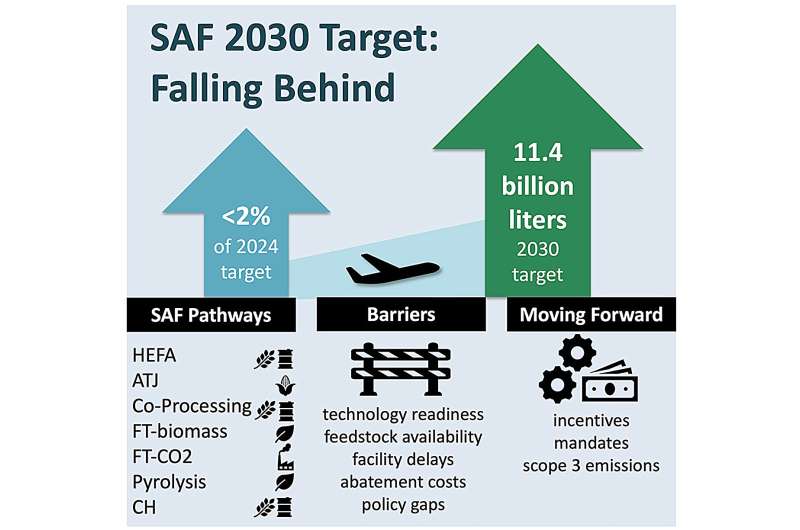
Sustainable aviation fuel, or SAF, has become one of the aviation industry’s most heavily promoted strategies for reducing carbon emissions. Yet a new analysis highlighted by Tech Xplore suggests that expectations surrounding SAF may be outpacing the realities of production, economics, and environmental impact.
Commercial aviation remains one of the hardest sectors to decarbonize because aircraft require highly energy-dense fuel for long-distance travel. Battery-powered aircraft remain impractical for large commercial operations, while hydrogen aviation is still in early development. As a result, SAF has emerged as the most viable short-term alternative because it can be used within existing aircraft engines and airport infrastructure.
The article explains that most sustainable aviation fuels are currently produced from biological materials such as used cooking oil, agricultural residues, and waste fats. While these feedstocks reduce dependence on fossil fuels, their availability is limited. Researchers argue that scaling SAF production to levels capable of supporting global aviation would demand far more raw material than currently exists through waste-based sources alone.
The article also raises concerns about land use and environmental trade-offs. Expanding crop-based biofuel production could compete with food systems, increase pressure on farmland, and affect ecosystems. In addition, sustainable fuels remain considerably more expensive than conventional jet fuel, creating economic challenges for airlines already operating under tight profit margins.
Despite these obstacles, governments and aviation companies continue investing heavily in SAF development. Regulatory targets in Europe and elsewhere are encouraging airlines to gradually increase SAF usage over the coming decades. However, experts cited in the article caution that SAF should not be viewed as a complete solution to aviation emissions.
Instead, the article presents SAF as one component of a broader strategy that must also include more efficient aircraft designs, operational improvements, reduced fuel consumption, and continued research into future propulsion technologies. The discussion ultimately reflects a growing recognition that decarbonizing aviation will likely require multiple parallel approaches rather than a single technological fix.
