

(Image: Synopsys)
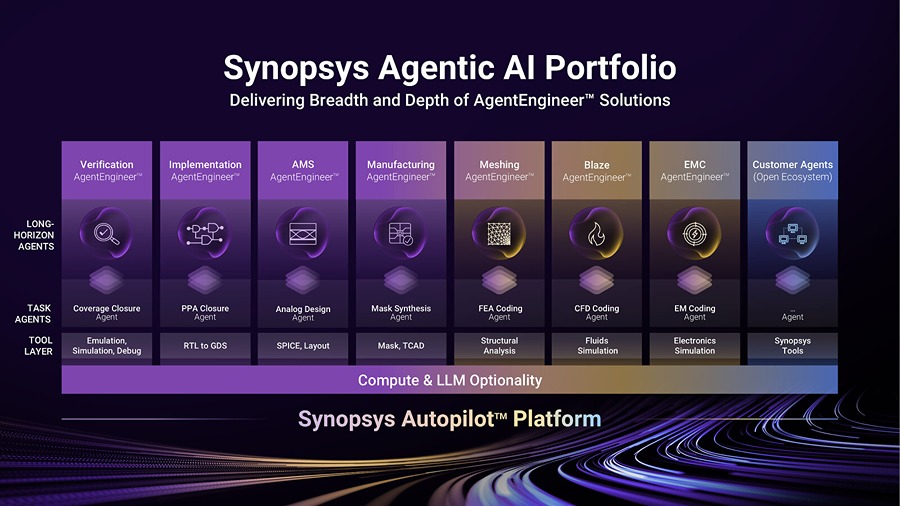
SUNNYVALE, CA, Sep 30, 2026 – Synopsys’ new AgentEngineer portfolio uses AI agents to plan and execute chip and systems engineering workflows through its Autopilot Platform. The agents cover verification, system validation, implementation, analog design, manufacturing, and simulation and analysis.
“Our customers are re-engineering their engineering workflows across semiconductor and systems products to keep pace with increasing system complexity and tight market windows,” said Ravi Subramanian, chief product management officer at Synopsys. “Synopsys’ portfolio of AgentEngineer solutions and the Autopilot Platform enable customers to accelerate their shift from AI-assisted design to autonomous engineering, built on trusted EDA and simulation and analysis engines.”
Engineering Workflows and Tasks
AgentEngineer combines agents that manage extended workflows with agents assigned to specific tasks. Both use Synopsys electronic design automation (EDA) and simulation and analysis tools.
Supported tasks include autonomous coverage closure, software bring-up and validation, multi-die 3DIC assembly, and power, performance and area (PPA) closure. Other applications include analog layout synthesis, design migration, mask synthesis, combustion, resonance and signal integrity analysis.
Orchestration and Data Controls
The Autopilot Platform coordinates agents, manages access to design knowledge and controls workflow execution. It also provides telemetry and governance.
- Infrastructure and model choice: Customers can use Synopsys, partner and third-party infrastructure, models, data, agents, workflows and integrations.
- Engineering context: Synopsys’ cognitive model combines engineering knowledge, tools, reusable skills and memory to interpret design intent and guide workflows.
- Security and data management: The platform uses access controls, encryption, runtime guardrails and configurable architecture to protect customer, partner and Synopsys intellectual property.
- Execution efficiency: The platform uses APIs and reasoning over proprietary engineering context. This reduces token use, cost and latency; the announcement provides no comparative figures.
Customer and Technology Engagements
“As a fast-growing innovator developing next-generation processor architectures, we are continually looking for new ways to accelerate engineering execution and improve productivity across our design workflows,” said Alon Mahl, VP of verification, AheadComputing. “The Synopsys AgentEngineer technology extends AI beyond task assistance to help automate complex workflows and accelerate engineering execution. From RTL handoff through implementation, ECO, and signoff, the Synopsys Implementation AgentEngineer helped us reduce manual engineering effort and accelerate design convergence, enabling our engineering teams to focus more time on the differentiated aspects of our processor architecture.”
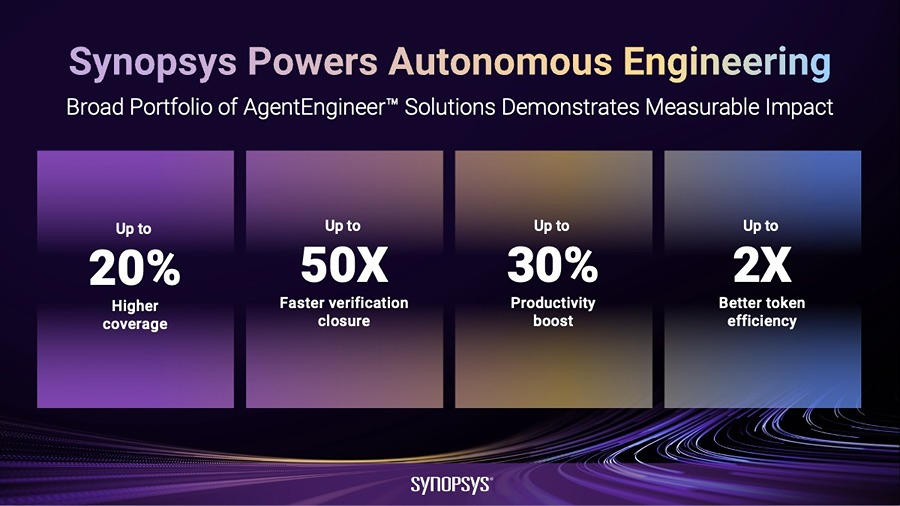
“We achieved a 10–30% productivity boost in RTL code generation with Synopsys Verification AgentEngineer capabilities,” said Toshio Yoshida, senior vice president and head of the advanced computing development unit at Fujitsu. “This was driven by highly efficient generation of SystemVerilog assertions, wrapper modules, and parameterized modules, as well as code refactoring.”
“Advancing the productivity and efficiency of our verification teams is critical as design complexity continues to increase across next-generation computing platforms,” said Manoj Selva, vice president, product enablement, Intel. “Our work with Synopsys Verification AgentEngineer technology highlights the promise of agentic AI for debug, enabling engineers to accelerate issue resolution across verification environments. We believe these advancements can help reduce verification bottlenecks, improve engineering efficiency, and accelerate the delivery of our silicon innovations.”
“Our engineers have consistently pushed the boundaries of analog and mixed-signal design and are continuously looking for ways to dramatically enhance design and layout productivity,” said Ching San Wu, vice president of MediaTek. “Building on the successful deployment of Synopsys SmartFloorplanning Technology, we are continuing our collaboration with Synopsys on the Agentic AI AMS Platform, driving the next frontier of autonomous analog engineering flows. We believe this transformative technology will fundamentally reshape how our teams create, optimize, and implement complex AMS designs.”
“Autonomous engineering requires AI agents that understand design intent, plan and execute complex workflows, and validate their results,” said Tim Costa, vice president and general manager of industrial and computational engineering at NVIDIA. “Synopsys is combining its silicon-to-systems expertise with NVIDIA accelerated computing and NVIDIA Agent Toolkit, including NVIDIA Nemotron models and the NVIDIA OpenShell secure runtime, to build long-running agents that help engineers improve design quality and accelerate development.”
“Breakthroughs in AI increasingly depend on breakthroughs in memory: the industry calls for higher bandwidth, greater efficiency, and faster innovation cycles,” said JY Choi, executive vice president and head of memory design technology at Samsung Electronics. “Synopsys agentic AI solutions are helping Samsung’s engineering teams accelerate complex development workflows, allowing us to focus more effort on innovating the advanced memory technologies that power the next generation of AI infrastructure.”
“As AI drives the shift to multi-die architectures with unprecedented power densities, increasingly complex power delivery networks demand new approaches for power integrity signoff,” said Aveek Sarkar, director of the ecosystem and alliance management division at TSMC. “Through our enduring partnership with Open Innovation Platform® (OIP) ecosystem partners like Synopsys, we are successfully enabling agentic AI-based solutions to accelerate critical power integrity analysis workflows. As advanced packaging designs rapidly grow in scale and complexity, these AI-based solutions significantly boost engineering productivity and enable groundbreaking designs for next-generation AI systems.”
Synopsys reports more than 50 engagements involving AgentEngineer and the Autopilot Platform. Availability is planned at the end of 2026.
Source: Synopsys
About Synopsys

Synopsys Inc. is a U.S. software and semiconductor technology company founded in 1986. The company develops electronic design automation software, semiconductor intellectual property, and verification tools used to design and test integrated circuits. Its products help engineers design, simulate, verify, and manage semiconductor chips and electronic systems. Synopsys also provides software security testing and engineering analysis tools through internal development and acquisitions. The company serves semiconductor manufacturers, electronics companies, system integrators, and software developers. Its customers operate in industries such as semiconductors, automotive, aerospace, consumer electronics, telecommunications, and data centers. Synopsys is headquartered in Sunnyvale, CA. The company employs about 28,000 people worldwide and serves customers across global technology sectors. Synopsys operates offices across North America, Europe, and Asia.
