

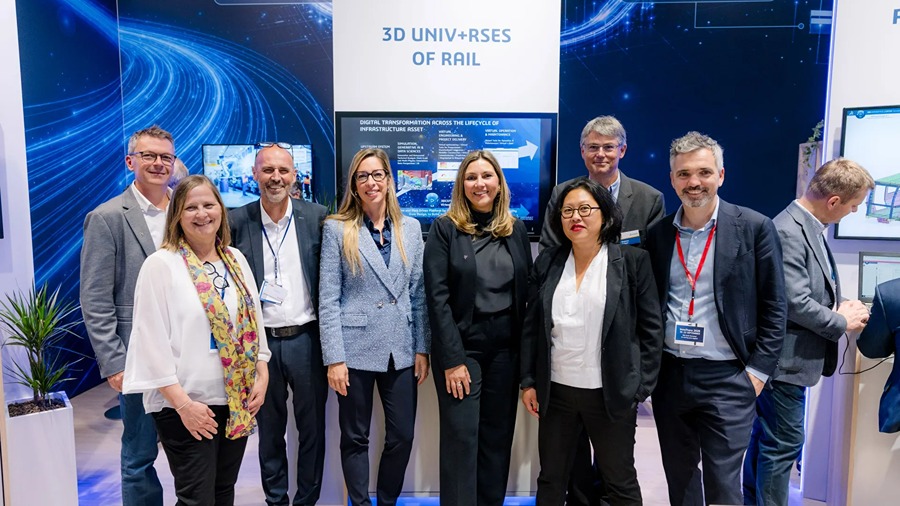
PARIS, France, Sep 25, 2026 – SYSTRA and Dassault Systèmes are collaborating on virtual twins for rail and infrastructure engineering. The work combines SYSTRA’s sector expertise with Dassault Systèmes’ 3D UNIV+RSES, powered by 3DEXPERIENCE agentic platform.
The companies are exploring digital services that bring stakeholder data, models and engineering expertise into shared environments. The aim is to help project teams compare options and assess their impacts during planning phase.
Dassault Systèmes’ 3D UNIV+RSES connects virtual twins to one another and their environment by combining data, models and scientific AI. Dassault Systèmes says the AI is designed to protect users’ data.
The collaboration by SYSTRA and Dassault Systèmes explores infrastructure design, simulation, testing, optimization and management throughout an asset’s lifecycle. Data control, digital trust and technological sovereignty are considerations for the work involving infrastructure and public and private stakeholders.
“Through this initiative, SYSTRA reaffirms its ambition to be a driving force behind digital innovation in the rail and infrastructure sectors, alongside major technology partners. The virtual twin is a powerful tool for improving design and decision-making, and for supporting our clients throughout the entire lifecycle of their assets. Together with Dassault Systèmes, we aim to accelerate the development of high value-added digital services, delivering ever safer, more reliable and more sustainable infrastructure,” said Prisca Flattot, senior vice president technical & operational performance, SYSTRA.
“The future of infrastructure will be built at the intersection of industry expertise and virtual worlds. With 3D UNIV+RSES, Dassault Systèmes is pioneering a new class of world representation, combining modelling, simulation, real-world data and scientific AI – an AI that does not merely guess at the world, but truly understands it. This is the aim of our collaboration with SYSTRA: to enable engineers to experiment, learn and innovate before taking action in the real world, and to transform what is possible in the design of tomorrow’s infrastructure,” said Corinne Bulota, vice president, infrastructure, energy and materials industry, Dassault Systèmes.
The companies announced the collaboration during InnoTrans 2026.
Source: Dassault Systèmes
About Dassault Systèmes

Dassault Systèmes SE, founded in 1981 and headquartered in Vélizy-Villacoublay, France, is a global software company focused on 3D design, digital mock-ups, and product lifecycle management. The company develops virtual tools that enable real-world applications across industries such as healthcare, manufacturing, and consumer products. Its software portfolio includes CATIA for product design, SOLIDWORKS for mechanical engineering, DELMIA for manufacturing workflows, and SIMULIA for advanced simulation. These solutions are used in aerospace, automotive, industrial equipment, consumer goods, life sciences, and technology sectors. Dassault Systèmes employed approximately 24,000 people across 200 offices worldwide.
About SYSTRA

SYSTRA is an engineering and consulting firm focused on public transit and mobility infrastructure. It traces its origins to 1957, when France’s national railway created SOFRERAIL. The company has its headquarters in Paris, France. Services include transport planning, design, project management, construction supervision, testing and commissioning. It also provides digital engineering, asset management, cybersecurity, operations and maintenance services. Projects cover railways, metros, trams, bus systems, stations, roads, bridges, tunnels, airports and seaports. SYSTRA also works on urban developments and rail infrastructure for mining operations. Its clients include governments, cities, regional authorities, transit agencies, rail operators and project owners. The company reports operations in 80 countries and more than 3,500 projects in 2025. SYSTRA listed about 12,000 employees worldwide.
