

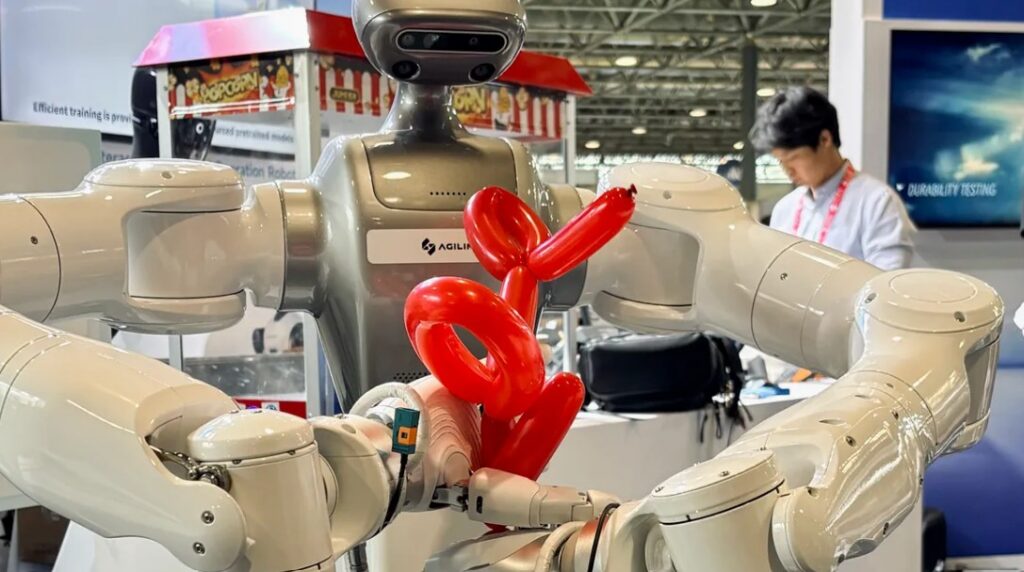
Robots have become increasingly capable of perceiving the world through cameras, sensors, and artificial intelligence, yet many still struggle with one of the most fundamental aspects of human dexterity: touch. An IEEE Spectrum article examines a new approach called Contact Intelligence, developed by Agility Robotics, that seeks to improve robotic manipulation by focusing on the physical interactions between robots and the objects they handle.
Traditional robotic systems often rely heavily on vision and precise object models to plan movements. While effective in controlled environments, these methods can fail when objects are unfamiliar, partially obscured, or positioned unpredictably. Humans, by contrast, routinely use contact, force, and tactile feedback to manipulate items without needing perfect visual information. Contact Intelligence aims to bring some of this adaptability to robots.
The framework treats contact not as a problem to be avoided but as a valuable source of information. Instead of attempting to move through space without touching surrounding objects, robots are encouraged to use physical interactions to guide and stabilize manipulation tasks. By monitoring forces, friction, and object responses, the system can make adjustments in real time, allowing the robot to perform tasks that would be difficult using vision alone.
This approach is particularly relevant for warehouses, manufacturing facilities, and logistics operations, where robots frequently encounter cluttered environments and objects of varying shapes, sizes, and materials. Tasks such as grasping, repositioning, stacking, and sorting can benefit from a deeper understanding of contact dynamics. Rather than requiring exact models of every object, the robot learns to exploit physical interactions to achieve desired outcomes.
The work reflects a broader trend in robotics research toward embodied intelligence, the idea that intelligent behavior emerges not only from computation but also from interaction with the physical world. Contact Intelligence combines advances in machine learning, control systems, and physics-based reasoning to create more adaptable robotic behavior.
As robots move into increasingly unstructured environments, the ability to understand and use contact may become as important as vision. Agility Robotics’ approach suggests that future machines will rely not only on what they see but also on what they feel, enabling more reliable and human-like manipulation of the world around them.
