

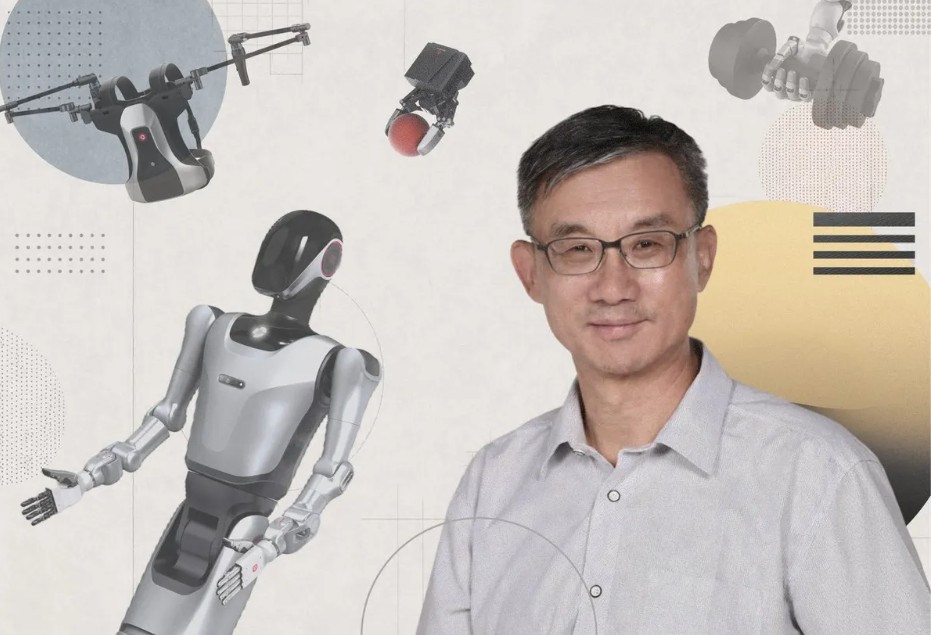
Led by robotics pioneer Michael Yu Wang, DAIMON Robotics has developed a massive omni-modal dataset for physical AI, designed to accelerate real-world deployment of general-purpose robotic foundation models (source: DAIMON Robotics).
A recent feature in IEEE Spectrum explores a major shift in robotics: giving machines a sense of touch to complement vision and language. At the center is DAIMON Robotics, a Hong Kong-based startup working to close one of the biggest gaps in artificial intelligence: the ability to physically interact with the world in a reliable, humanlike way.
The company has introduced Daimon-Infinity, described as the largest multimodal dataset for physical AI. It combines vision, language, and high-resolution tactile sensing across a wide range of real-world tasks, from household chores to industrial assembly. By collecting millions of hours of interaction data and releasing a portion publicly, the initiative aims to address a long-standing bottleneck in robotics: the lack of high-quality physical interaction data needed to train general-purpose robotic systems.
Central to this effort is a shift from traditional Vision-Language-Action models to a new Vision-Tactile-Language-Action framework. Researchers argue that without touch, robots struggle with even basic manipulation tasks. They cannot reliably gauge grip force, detect slipping objects, or handle fragile materials. Tactile sensing fills this gap by capturing detailed information about contact, texture, deformation, and friction, enabling more precise and adaptive control.
DAIMON’s hardware plays a key role. Its fingertip-sized sensors contain over 100,000 sensing units, allowing robots to “feel” interactions at a level approaching human sensitivity. This capability is essential for dexterous manipulation, such as picking up delicate objects or using tools effectively.
The broader goal is to accelerate embodied AI, where machines learn not just from data but from physical experience. By integrating sensing, data, and learning frameworks, the approach aims to move robots beyond controlled environments into everyday settings such as retail, hospitality, and manufacturing.
While challenges remain in cost, scalability, and deployment, the work signals a turning point. Adding touch as a core modality could redefine what robots can do, bringing them closer to operating with the adaptability and precision seen in human hands.
