
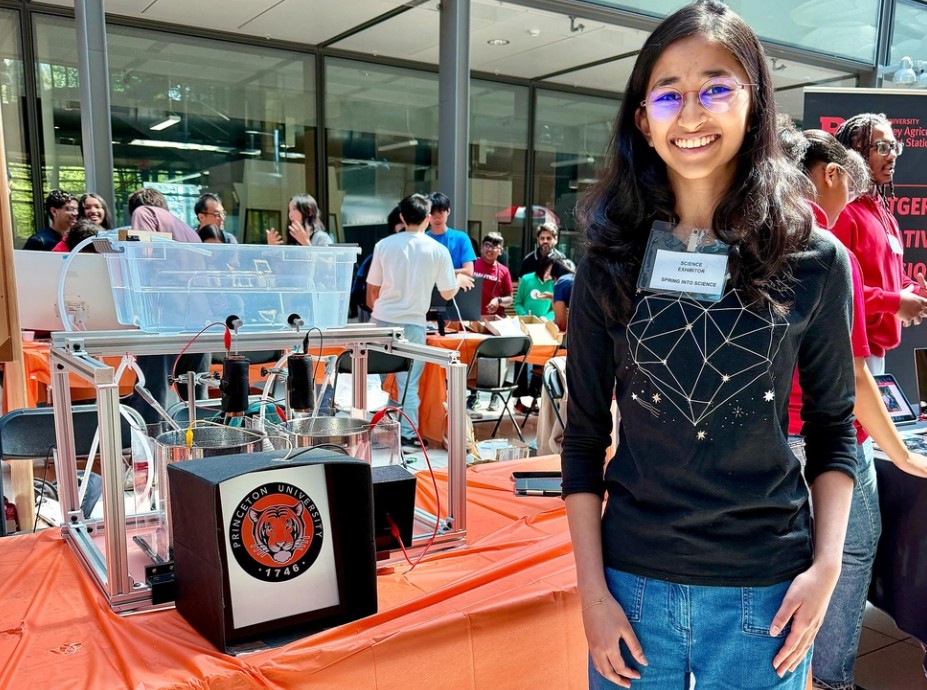
New Jersey high school student Ruchira Shree is turning her interest in mathematics and engineering into opportunities for Native American students. Her involvement with the IEEE Princeton Central Jersey Section led to an internship with the Alliance for Indigenous Math Circles, which organizes STEM camps for Indigenous students, tells IEEE Spectrum.
Shree volunteered at a weeklong camp in Santa Fe, New Mexico, where students explored mathematics through collaborative math circles and hands-on projects. Activities connected technical concepts with Indigenous traditions, including basket weaving and the geometry behind traditional designs. Indigenous STEM professionals also participated, giving students role models who shared similar cultural backgrounds.
A major part of Shree’s internship involved Radio Weaves, a program introducing students to amateur, or ham, radio. Ham radio allows communication without cellular networks or the Internet, but transmitting in the United States requires a Federal Communications Commission license. Shree and other interns led two-hour evening sessions designed to prepare students for the FCC technician license exam.
The interns customized the Gimkit learning platform with radio-related material reflecting topics covered by the test. Each intern worked closely with two or three students. Nearly all participants passed on their first attempt, and after retesting, every student ultimately earned a license.
Shree’s experience also highlighted financial barriers that can limit participation in other educational activities. After returning home, she founded Rukie Cookie, an initiative that sells homemade cookies to support chess classes and U.S. Chess Federation memberships for underserved children. She has funded six memberships, including five for students from the camp.
Shree plans to return to the program and hopes to introduce a formal chess component. She is also researching cognitive decline and considering future studies in mathematics and cognitive science.
Her experience shows that expanding STEM participation can involve more than teaching technical skills. Mentorship, cultural relevance, and practical financial support can help students see pathways into science and engineering.
